“AFRICA”: manufacturing the past
At the Musée d’art contemporain (MAC) in Marseille, Louisa Babari brings together photomontages, archaeological objects, a slideshow and a sound piece on ancient North Africa. The recovery of an erased past? The exhibition “AFRICA” does something stranger: it assembles a past that was never whole, and so shifts the question our time asks of images.
It all begins with the smallest historical unit there is, a proper name. Of Russian and Algerian descent, the French artist Louisa Babari discovered, through the work of the archaeologist Ahmed M’Charek, that her surname is an ethnonym attested in North Africa since Antiquity and linked to the Numidian kingdom. From this intimate find the exhibition climbs back link by link, from the name to genealogy, from genealogy to the archaeological trace, from the trace to Roman Africa, and from the province to the goddess Ifri or Ifru, whose name would end up designating a continent. There is no original Africa beneath the accumulated meanings. Territories, empires, fantasies and political geographies have settled on the word in layers. The exhibition’s title is already a collage in itself.
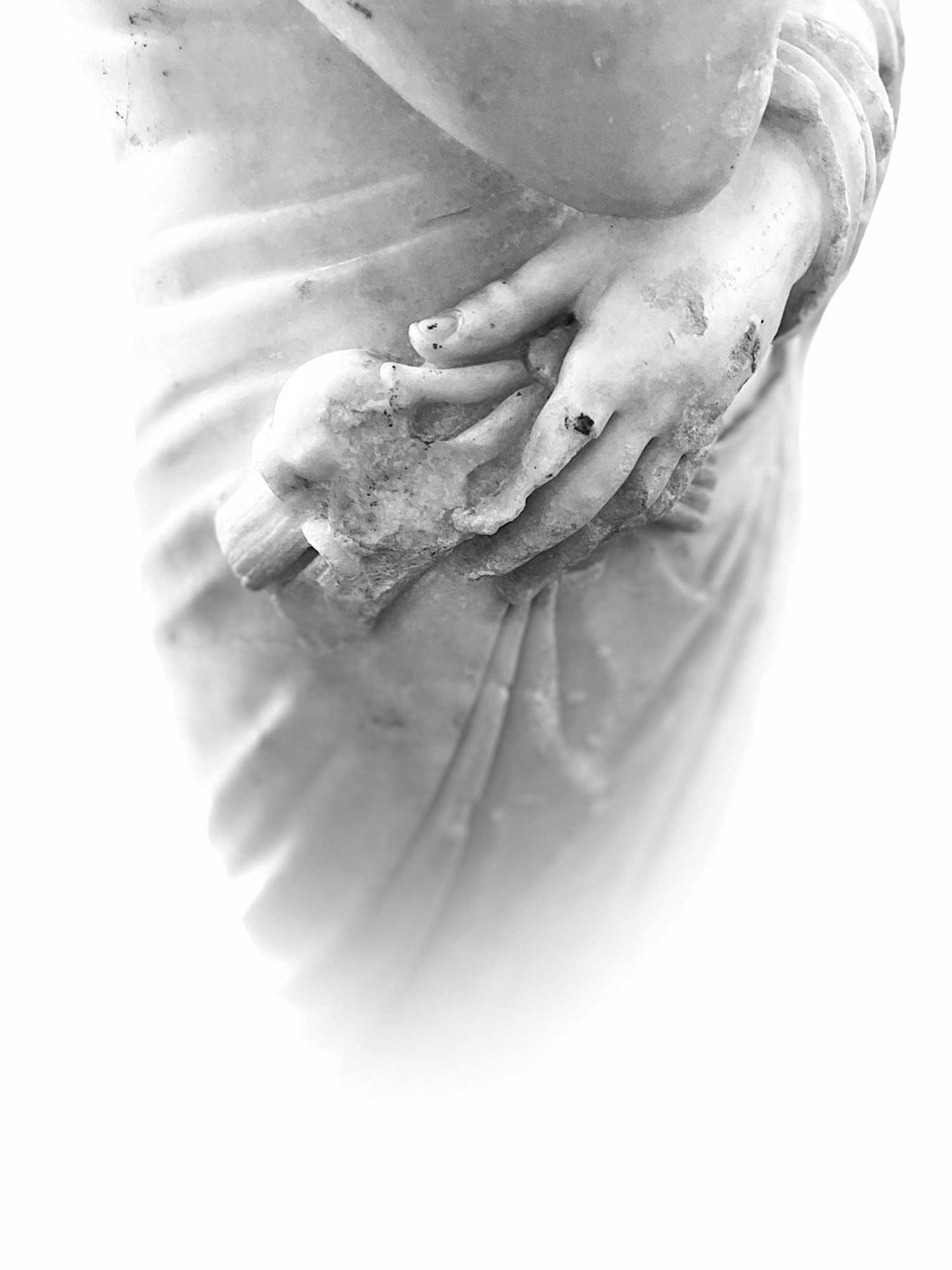
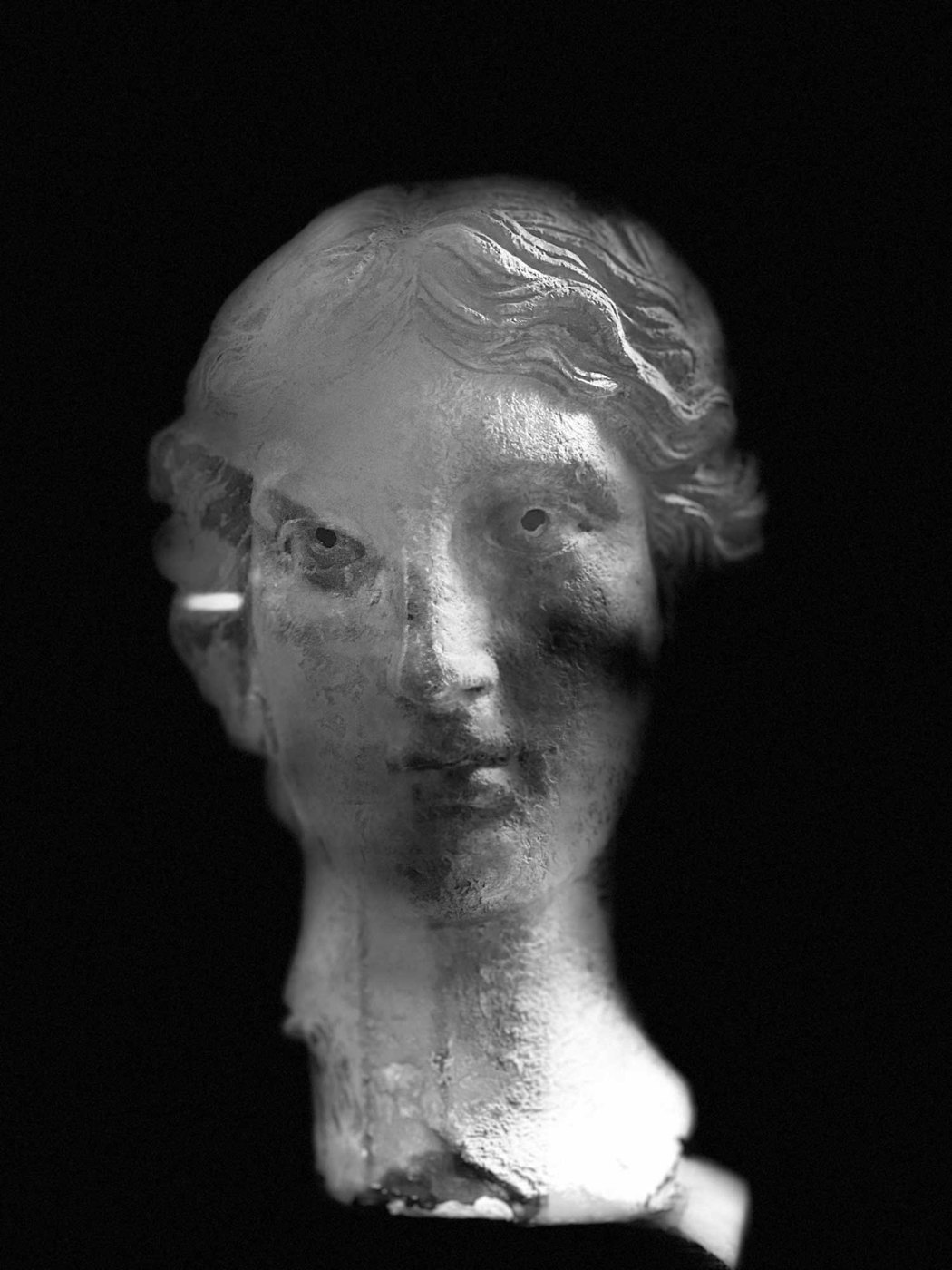
The room sets two regimes of historical knowledge face to face. In a lit vestibule, the exhibits, each with its provenance and inventory number: a stele of Saturn unearthed at Skikda, a Punic glass pendant, a Roman spearhead and, on a screen, the animated reproduction of a third-century inscription in which the name Africa appears. Then you pass into the dark, where eight photomontages enlarged on tarpaulins pierce the gloom with their white halos, between two broken columns, a slideshow and a twenty-five-minute electroacoustic composition that invents a sonic Numidia from scratch. The stele claims to have been there. The collage replies that no one is quite sure any more what there means. In these images coexist fragments of statuary cut from old scholarly journals, Chaoui women photographed in the twentieth century, contemporary silhouettes, horses, ruins. No chronological purity, no reconstruction. The artist speaks of “possible visions,” assembled as intuitively as they are documented, a way of “roughing up” the archive, of introducing accidents into it, which led the philosopher and art critic Florian Gaité, in the monograph published by Éditions AA, to call her an anarchivist.
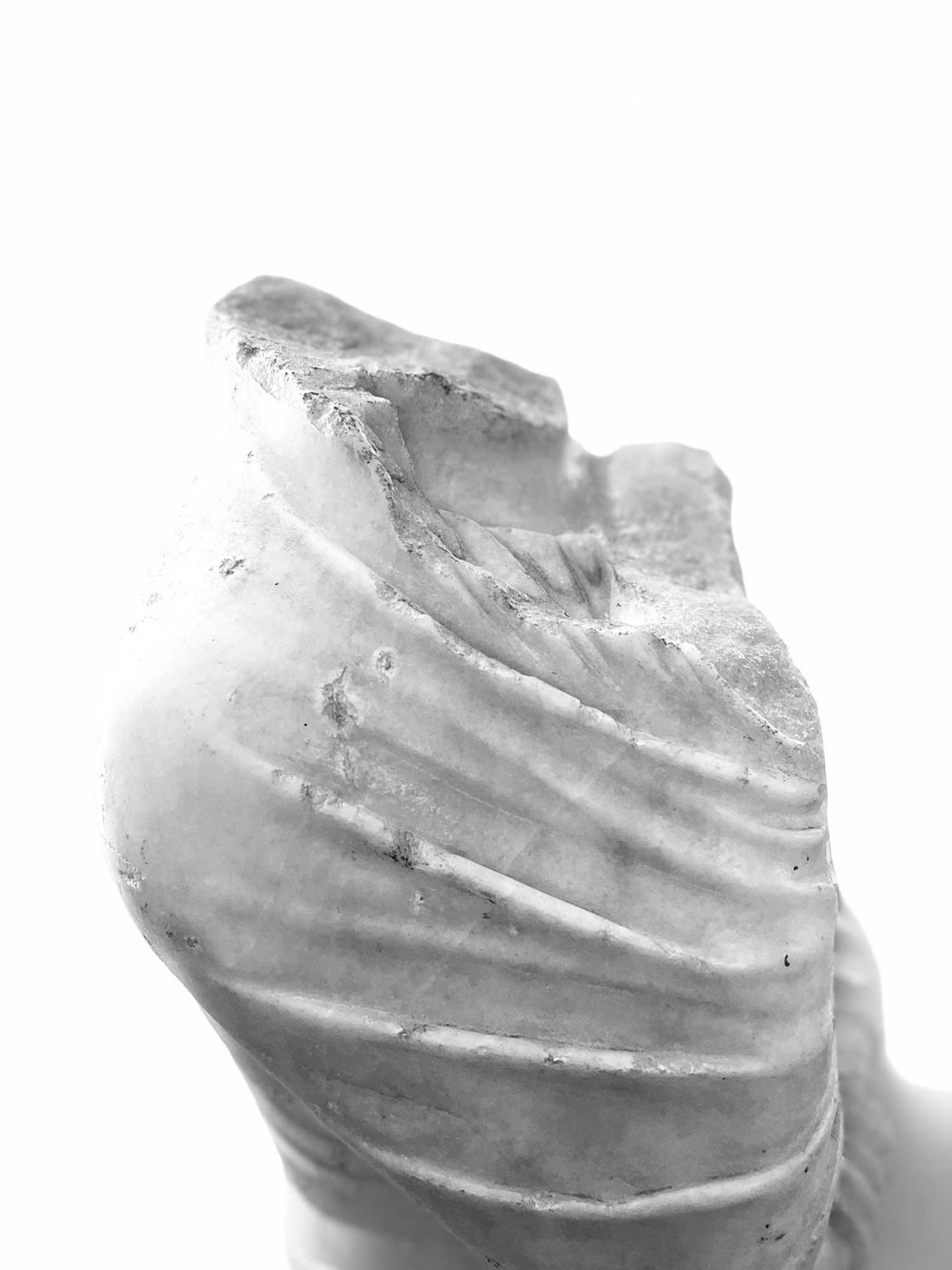
This is where the exhibition parts ways with a narrative that has become dominant. Much current practice works by a logic of recovery: something was erased, it is found, made visible, continuity is restored. The political value of this gesture is real; colonisation destroyed and reorganised whole bodies of knowledge. The danger lies elsewhere, in the aestheticisation of loss itself, when the precolonial becomes a sanctuary of integrity, a substitute origin, desirable precisely because it is imagined intact. Babari cuts this temptation short through the very form of her images, which display how they were made. Her collage starts from the observation that the image was never whole, just like the name Africa, which crossed Antiquity only as recorded by its adversaries. Instead of restoring, it organises co-presences, a ruin against a contemporary body. The rupture between past and present remains visible; it simply stops being final.
The collage manufactures the conditions under which a lineage becomes imaginable, and shows it
Refusing nostalgia
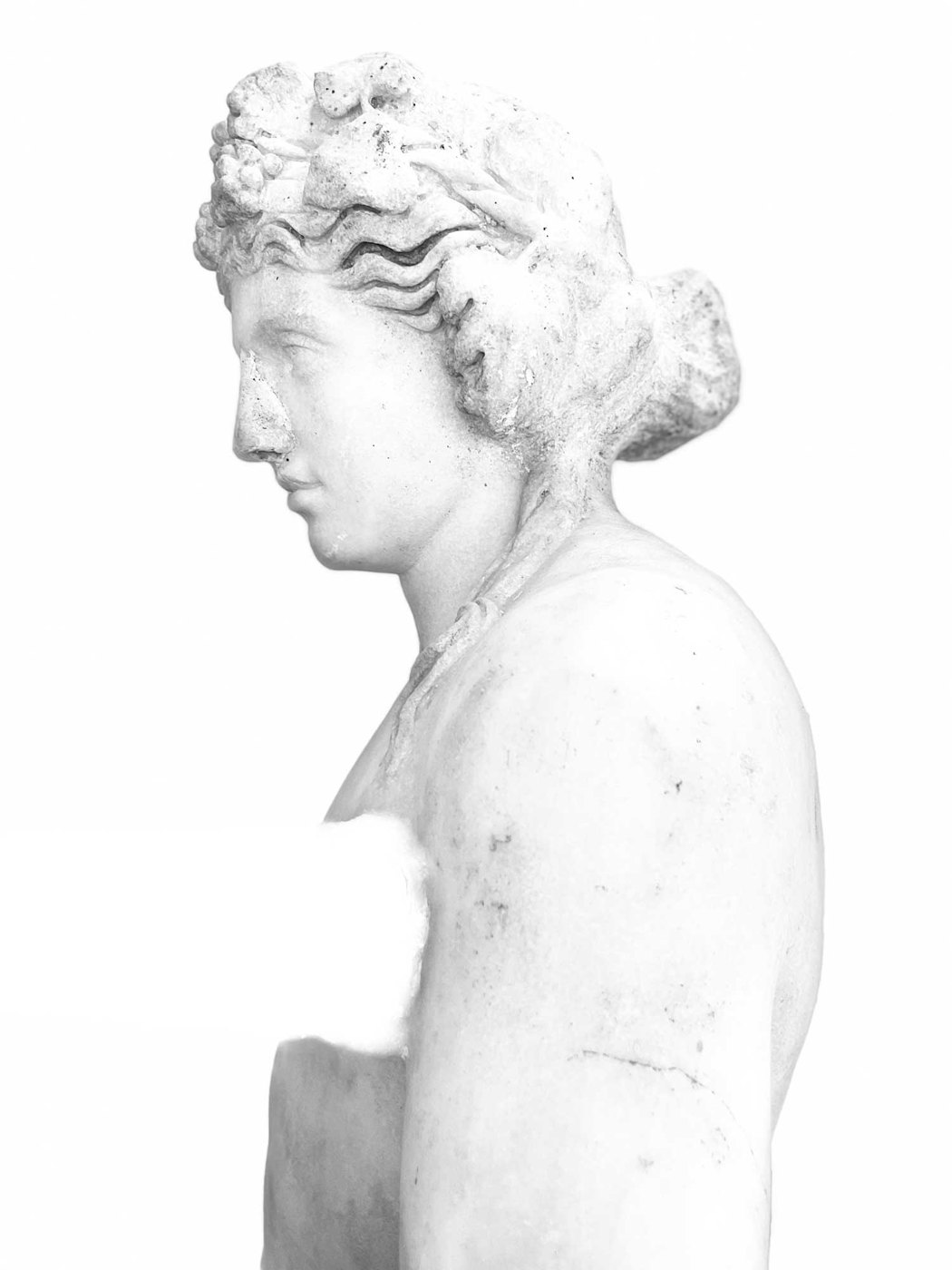
A contradiction runs through the exhibition, though; it is its nerve. Babari warns against nostalgia and says she wants to accept Algeria “as it is today, with its ambiguities and contradictions.” Yet “AFRICA” methodically produces the visual conditions of desire for the past: darkness, depth, lions and horsemen, mineral matter, long time. Can an exhibition refuse nostalgia while manufacturing its atmosphere? The answer may lie in the slideshow. The artist describes her photographs of statues as portraits taken in the mirror of those who looked at them two thousand years ago. The idea is beautiful and unstable; looking at the same object grounds no genealogical continuity. But that is precisely what the montage takes on: continuity is not found by the work, it is produced by it. The collage manufactures the conditions under which a lineage becomes imaginable, and shows it.
It remains to understand why collage serves here as method and not as ornament. An image can present itself as a window; it then shows a state of the world and is judged by its likeness. It can also present itself as an apparatus, and what it produces is an arrangement of fragments whose relations become perceptible. The Russian avant-gardes made this second definition a programme, coming out of a historical rupture, when the task was to manufacture forms capable of installing a new consciousness. Photomontage there owns its cuts and does without any illusion of continuity.
The comparison implies no claimed lineage. It rests on the vocabulary Babari uses spontaneously. Born in Moscow, trained in Russian studies and film, she describes her collages as matrices close to film stock, thought in shots and montage, and her Journal d’un étudiant algérien à Moscou, acquired by the MAC, follows the circulation of Algerian students in the Eastern Bloc after independence. The rupture she inherits is colonial, extended by independence and by dispersal. In both situations the image stops being a container of information and becomes an instrument of reorganisation. Archaeology finds fragments, the archive classifies them, montage rearranges them, and history appears as an effect of their arrangement. “AFRICA” thus composes an Africa-image rather than an image of Africa, a field in which heterogeneous temporalities hold together without being reconciled. That is what allows the exhibition to produce the past without claiming to restore it.
The point is no longer to know what the authentic Africa was, but what becomes of images when we stop asking them to restore the past
Finally, it would be too convenient to detach the exhibition from the place that hosts it. The stele of Saturn was carried from Skikda to France in the nineteenth century, the acknowledgements line up the Louvre beside the museums of Algiers and Constantine, and the whole belongs to the Saison Méditerranée, the Grand Arles Express and the bicentenary of photography. A second collage is therefore at work on an institutional scale: Algeria, France, Antiquity, cultural diplomacy and heritage assembled under the sign of Africa. Displacement, restitution, reconciliation or simple institutional montage: the question deserves to stay open, and the exhibition, which shows so well how arrangements produce narratives, gives visitors what they need to ask it themselves. You leave having changed questions. The point is no longer to know what the authentic Africa was, but what becomes of images when we stop asking them to restore the past.