Ghost stories
Souki Belghiti’s stories of resistance
Demonstrations look like festivals, festivals like village fairs. In this general confusion of codes, Souki Belghiti trains her lens on a burning question: do our collective rituals still have any political or symbolic efficacy, or are they now only media simulacra of a revolution that has become impossible?
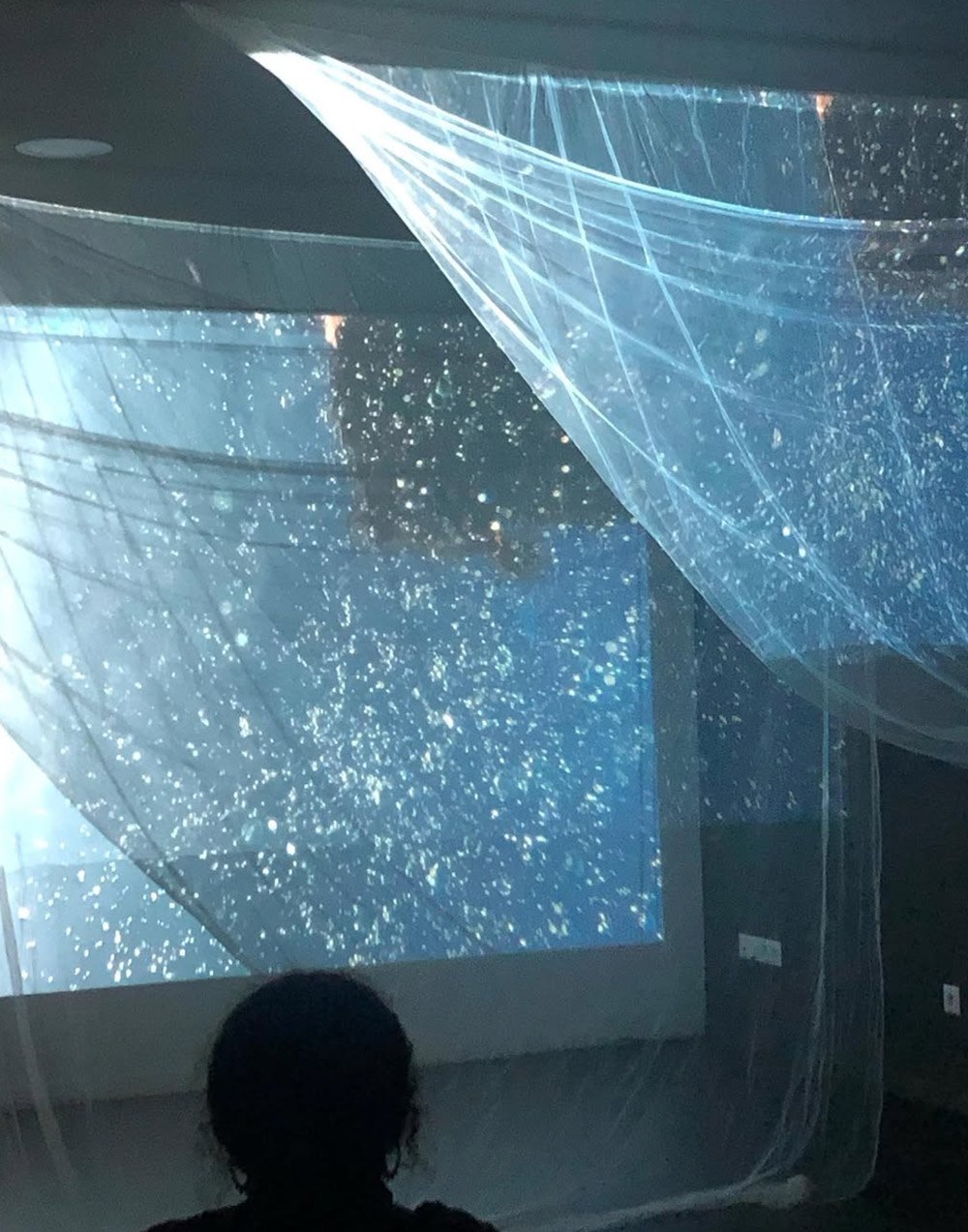
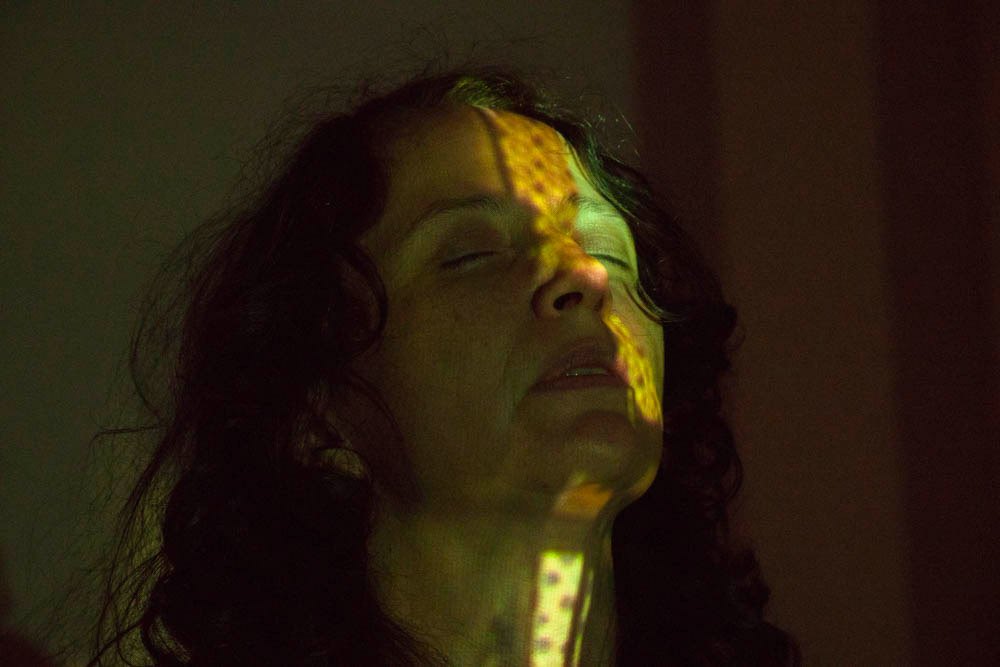
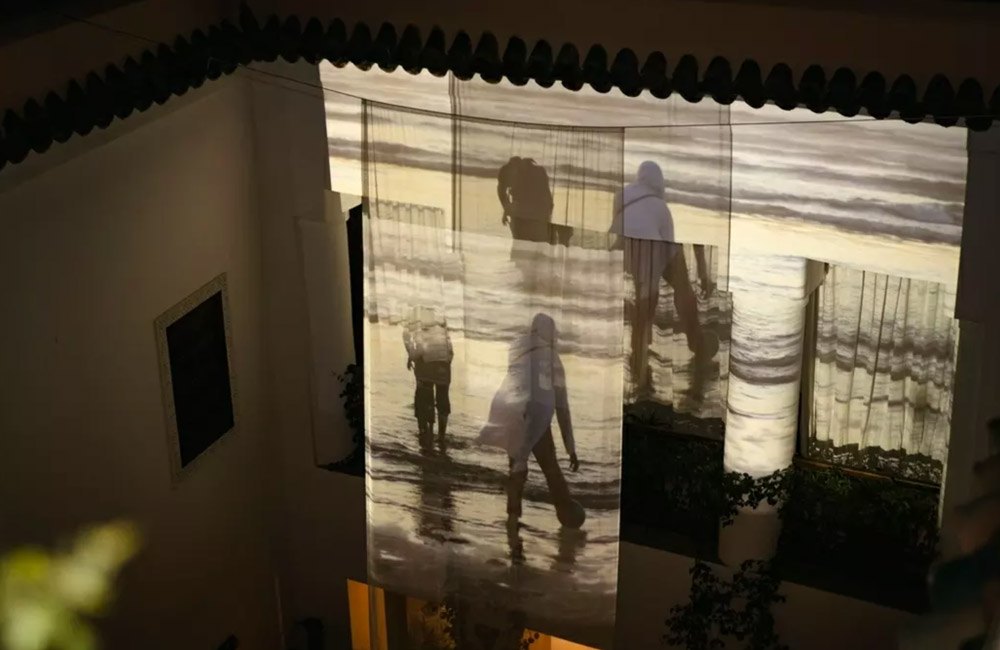
French-Moroccan, a graduate of Louis Lumière after studying biology, Belghiti belongs to the generation of artists who grew up in the in-between, geographic and cultural. This balancing act gives her a particular sharpness in detecting the pretences of our time. The hybridity of her path – between science and image, between the Maghreb and Europe – shapes a gaze able to undo the obvious. It is from this border that she watches our contemporary world transform. In Marchands de sable (2023), where lullabies in darija accompany sea images projected onto a tulle veil, she questions the fragility of oral transmission and the loss of popular stories in the face of cultural uniformity, while Surface sensible (2023) makes the body a site where memory is exposed, images projected onto skin revealing how far our identities are shaped – even absorbed – by the images that precede us.
Belghiti’s current trajectory grows out of these formal experiments. Her photobook, We Keep Burning Into the Silent Night, starts from the streets of Casablanca to examine an era in crisis. The artist documents a turbulent youth, “caught in a vice, deprived of real prospects for the future, longing for deep political change it struggles to put into words, while demanding the instant gratification promised by consumerism.” A youth revolutionary out of frustration, consumerist by conditioning, surveilled by systemic necessity, burning with an energy that finds no viable political outlet and consumes itself in rituals of release that look more and more like prefabricated stagings.
The permanence of the logics of power
If Casablanca’s youth seems trapped between revolution and consumption, it may be because the city itself carries the traces of a domination that has changed shape without disappearing. Réverbérations, her work on the Central Market of Casablanca, reveals this archaeology of power. The project, first a sound piece and then an animation – a mix of animation and archive photographs – displays a documentary method that echoes the questions raised by We Keep Burning Into the Silent Night. Where the photobook captures contemporary turmoil, Réverbérations dives into the layers of time to understand how the present is rooted in History. For months she recorded the voices of the traders, collecting their memories as so many fragments of a world being erased.
Through the testimonies of these men and women who lived through the 1953 bombing, the famine orchestrated by the colonists and the struggles for independence, Belghiti reveals structures of continuity in systems of power. “The colonists made way for the investors,” but the mechanisms of extraction and exclusion persist. This permanence of the logics of power under new masks may explain why our rituals of protest seem so futile: they attack the symptoms without touching the structural causes.
“When I started this work, I was deeply affected by the massacres in Palestine, the complicity of the Western media and the inaction of international institutions; I was going through a deep spiritual crisis,” Belghiti says. And how do you create when the world is collapsing? When horror becomes daily, when official speech makes itself complicit through its silence or its euphemisms? Contemporary art can no longer spare itself a reflection on its own powerlessness before the catastrophes under way. “We are the ancestors of the future: our blindness obstructs what is possible and mutilates what could become,” the artist observes.
But for the artist, “the point is not to photograph, cynically, our burning world, but to make silence within oneself in order to welcome mourning.” Welcoming mourning: perhaps this is what our collective rituals no longer know how to do. Caught in permanent acceleration, in the injunction to positivity, we have lost the basic capacity to fall silent, to leave room for the necessary void. We have to refuse the anaesthetics the society of the spectacle offers us, because without mourning no metamorphosis is possible, only the compulsive repetition of the same empty gestures.