Sarah Amrani
Portfolio · Interview by Basma Mansour
Finding her place between two worlds, negotiating an identity that straddles contradictory heritages: the Moroccan-Dutch artist, who lives and works in Rotterdam, scrutinises the interstices of a bicultural identity and captures what floats between assignment and emancipation.
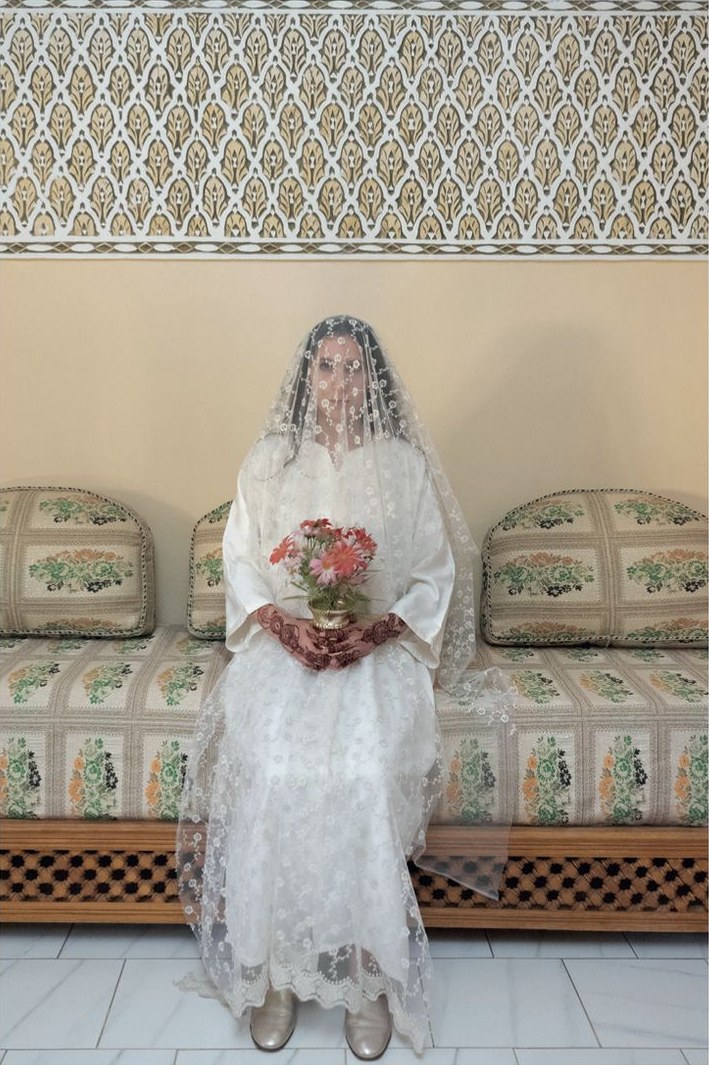
“My work always takes root in an intimate experience, in the feeling of being caught between two cultural realities. I grew up with the strange impression of not belonging fully to either of the worlds I come from. For a long time I felt this ambiguity of identity as a kind of discomfort; over time it became an essential source of artistic reflection. Photography lets me explore this in-between, give form to the feeling of being perpetually in transit.
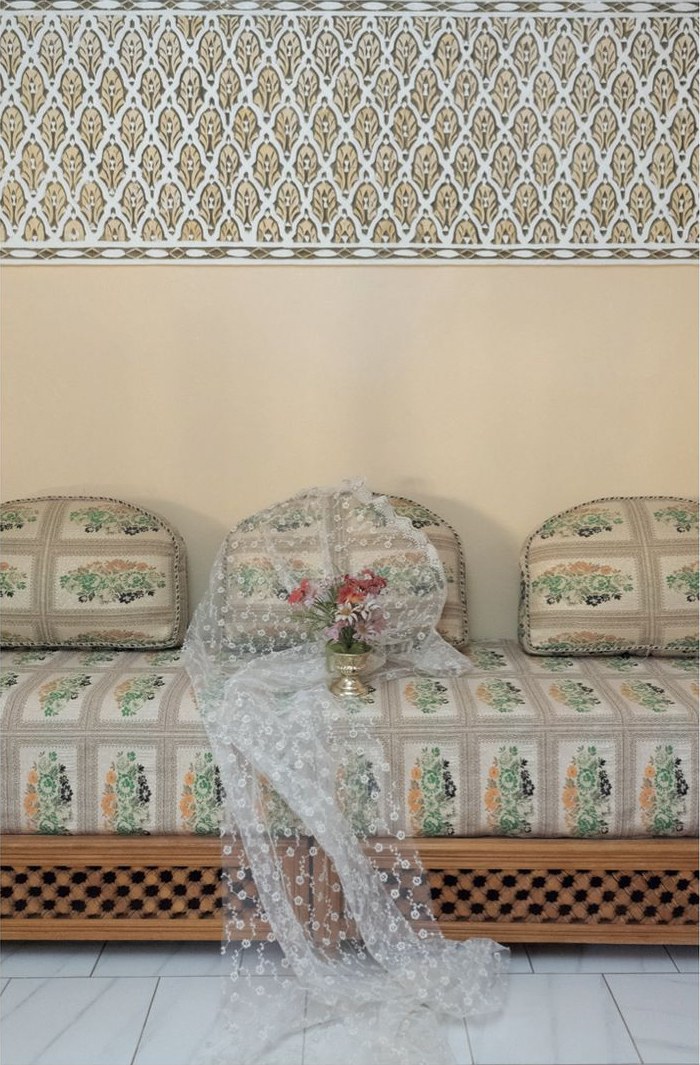
The Oujda series was born of summers spent at my grandparents’ home, punctuated by traditional Moroccan weddings. These celebrations, sumptuous and rigorous – where everything is meticulously orchestrated: the outfits, the gestures, the rituals repeated identically – quickly became a privileged space of observation for me. Fascinated by the ambivalence of these moments, at once intimate and spectacular, I first tried to document the staging. Gradually the series evolved and widened into a larger field of exploration. The wedding is now only the starting point, a pretext to question underlying tensions, especially those tied to gender roles and to the tacit assignments I try to subvert. A man’s jellaba on a woman’s body, hair uncovered where it should be hidden. These subtle shifts question the place of women in public space and the way they negotiate their presence in a world structured by rigid norms.
I deliberately seek ambiguity and leave room for many interpretations. My aim is not to impose a fixed reading but to express a state of being. Because I use my own body to explore this bicultural identity, my work is anchored in the intimate while reaching far beyond my personal story. That is why I never fully reveal faces in my photographs: this is less my own story than a collective questioning.”