Amazighes: beyond the colonial gaze
Far from conventional museum displays that freeze non-Western civilisations in an eternal ethnographic past, the exhibition “Amazighes: cycles, parures, motifs,” a collaboration between the Mucem and the Fondation Jardin Majorelle in Marrakech, offers a dynamic reading in which Amazigh identity appears in all its complexity.
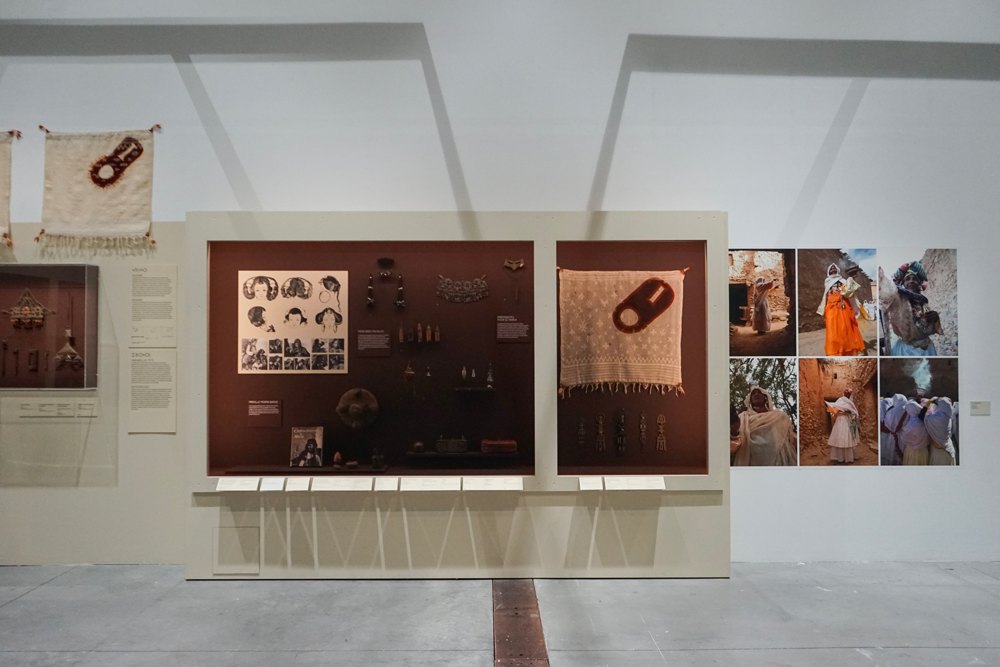
Marseille becomes the epicentre of a fascinating anthropological reflection. From the outset, the exhibition “Amazighes” makes a fundamental break in terminology. Dropping the term “Berber” – etymologically derived from “barbaros,” the incomprehensible foreigner – in favour of the endonym “Amazigh” is much more than a semantic adjustment. It is a lexical gesture that reaffirms peoples’ inalienable right to name themselves. “Imazighen,” the plural of Amazigh, carries the notion of free or noble people, an act of reclaiming identity that the curators Salima Naji, architect and anthropologist, and Alexis Sornin, director of the Yves Saint Laurent museums in Marrakech, chose to celebrate. As Salima Naji puts it: “Today we no longer say ‘Eskimo,’ we say ‘Inuit’: it is about peoples naming themselves with names they have chosen.” The choice belongs to a museum ethics that gives peoples back sovereignty over their representation, freed from the Western projections that long confined it to reductive categories.
The very structure of the exhibition, which brings together more than 150 objects from Morocco, Algeria, Tunisia and the Sahel, escapes the chronological linearity that usually governs the presentation of non-European cultures. Rather than a straight narrative – from origins to modernity – the route unfolds in thematic constellations that interpenetrate. This spatial organisation reflects a cyclical conception of time proper to Amazigh societies, in which seasonal return prevails.
Claudine Bertomeu’s scenography gives material form to this conceptual approach. The deliberately permeable exhibition spaces let visitors make visual connections between the different sections. This spatial porosity invites a free wandering, in which each visitor builds their own route according to their affinities. Time sequences telescope, bringing heritage objects and contemporary works into dialogue within a single sensory sphere.
Salima Naji and Alexis Sornin’s proposal also shatters the illusion of a monolithic Amazigh culture. It reveals the diversity of cultural expressions from the different regions of the Maghreb and the Sahel, questioning the very relevance of a homogenising category.
A symbolic matrix
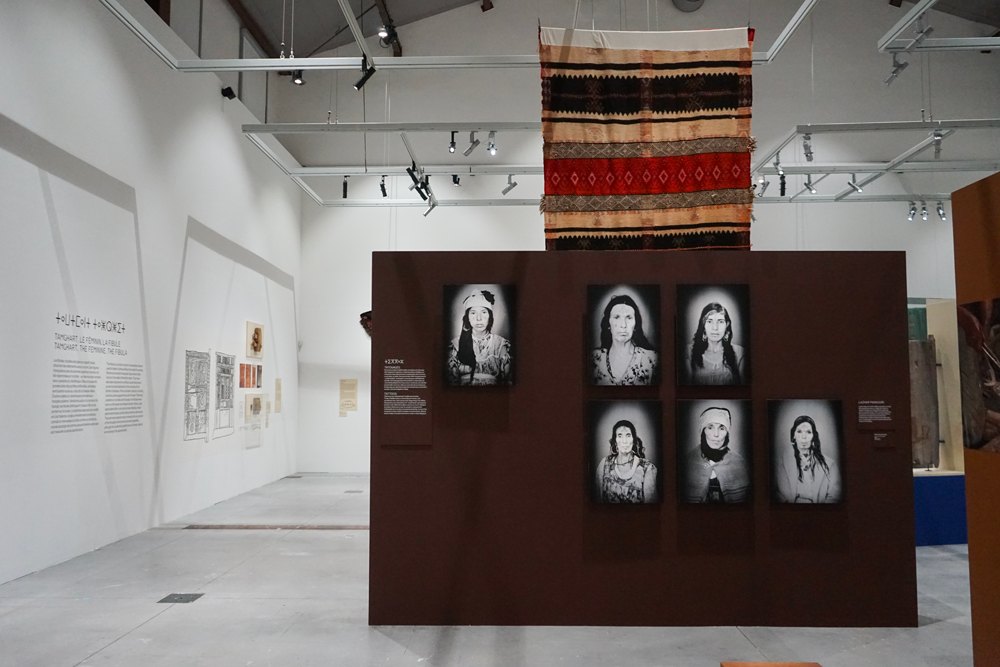
The Tamghart (The feminine) section opens the exhibition with a celebration of mother goddesses and the feminine matrix. Next come the spaces devoted to the “invisible protective circle,” where the ornamental motifs carved into the wood of doors and on wall hangings follow an apotropaic logic, meant to ward off bad luck and protect the home from harmful influences. At the heart of the route the cycle of life takes shape. Seasonal variations and the stages of existence are inscribed in everyday objects. “Amazighes” shows how natural cyclicity – lunar phases, spring rebirth, harvests – orchestrates women’s know-how in weaving, pottery and henna tattooing, without forgetting men’s goldsmithing.
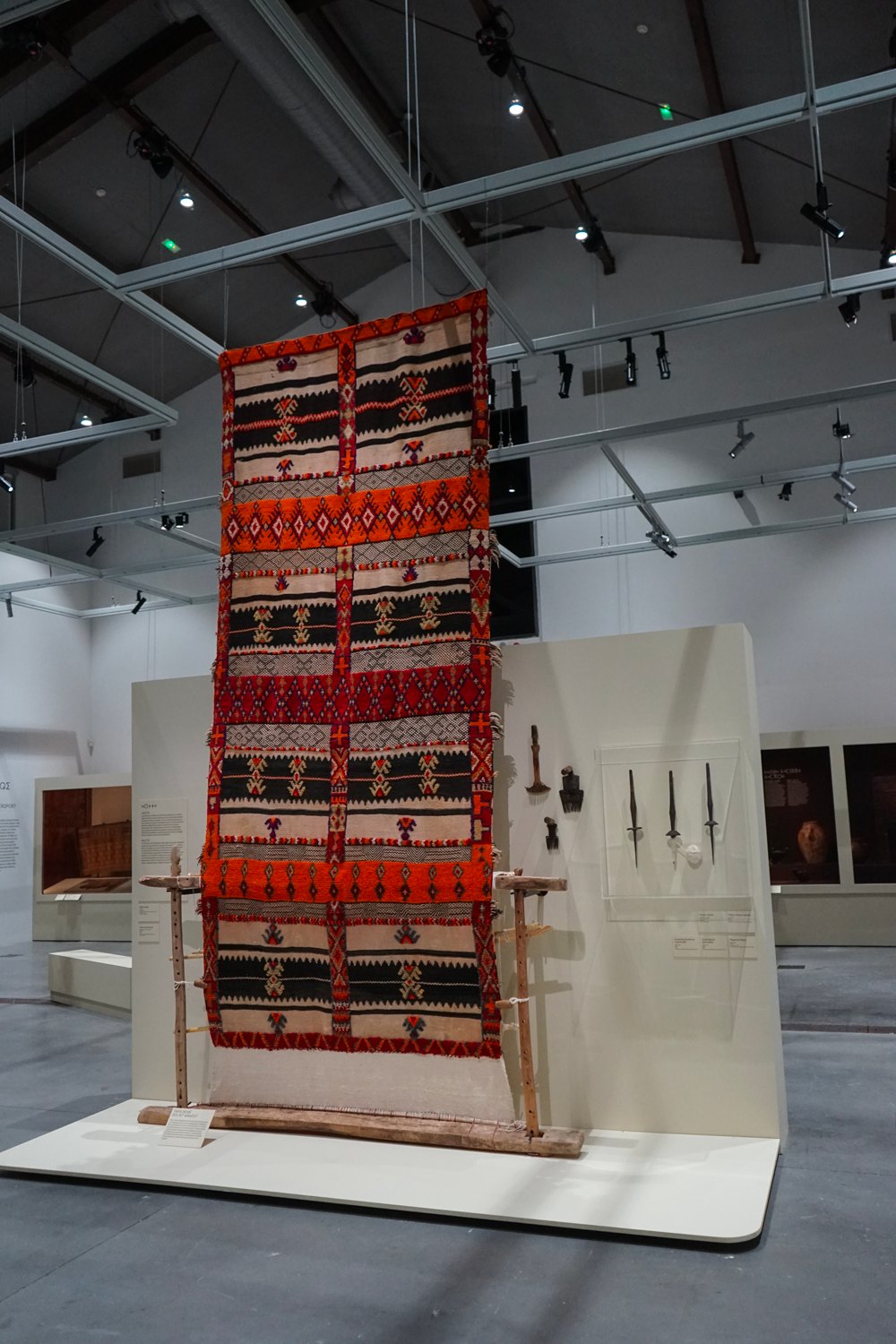
Against the reductive theories that long interpreted these practices as mere superstition, the exhibition restores their philosophical complexity. It shows how these symbolic devices articulate a true cosmology in which material signs mediate between the visible and the invisible.
The section A dismembered heritage confronts visitors with the mechanisms of cultural appropriation that gradually emptied Amazigh objects of their symbolic substance. The exhibition traces how the Western craze for so-called “Berber” aesthetics led to the systematic extraction of cultural goods from their original context. By valuing only the aesthetic dimension of Amazigh artefacts, the Western gaze simultaneously raised them to the rank of art objects and stripped them of their functional and symbolic complexity.
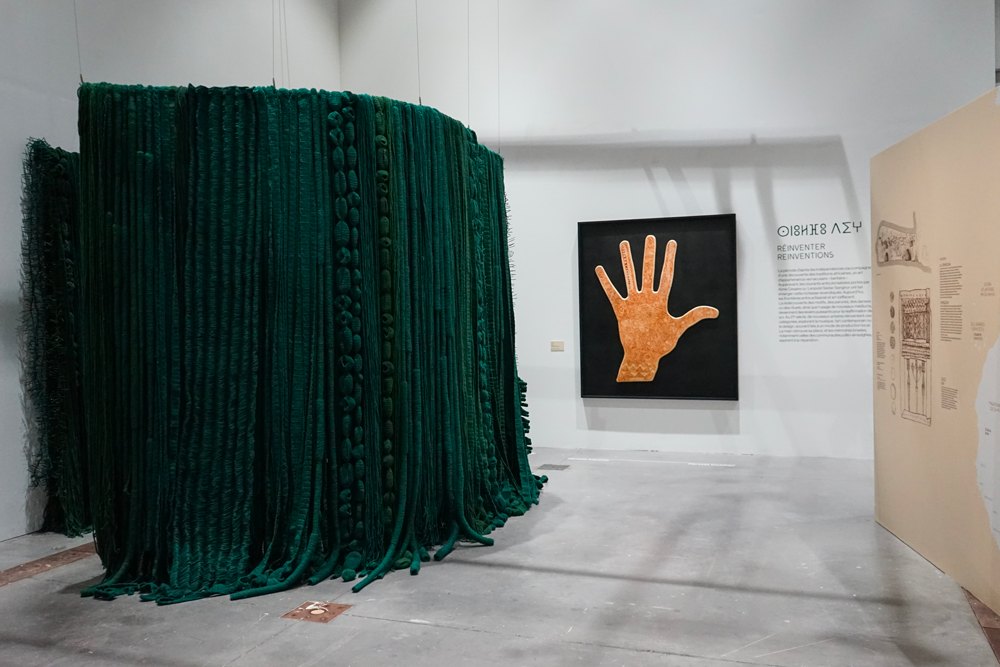
Yet the exhibition refuses to shut itself into an accusatory or nostalgic stance. Its final section, Reinventing, testifies to the persistent vitality of contemporary Amazigh culture. Contemporary works punctuate the route, showing a heritage that, far from fossilising, constantly reinvents itself by adapting to new media and contexts. Such is the work of Amina Agueznay, whose collaboration with traditional weavers ties heritage to contemporary creation. Or that of Farid Belkahia, whose “La Main,” painted in henna, pays homage to tattoo traditions.
Towards a decolonial museology?
The more than 150 objects shown by the Mucem go beyond the mere aesthetic contemplation to which the Western gaze had reduced them. Each fibula, each piece of pottery, each tattoo embodies a knot of social, ritual and philosophical meanings that the exhibition carefully restores. The exhibition methodically dismantles the mechanisms of capture and exoticisation that long governed the Western gaze on North African cultural production. “Amazighes” thus makes a triple shift: it breaks with the traditional ethnography that reifies non-Western cultures; it moves beyond the purely aestheticising approach that reduced Amazigh objects to their decorative dimension; and it crosses the artificial separation between historical heritage and contemporary expression. In doing so, it proposes a new museum paradigm in which the exhibition becomes a space of intercultural dialogue that fully recognises the communities it presents.