At Le Cube, the goal is the path
Founded in Rabat in 2005, Le Cube – independent art room is a laboratory of ideas where art breaks free of established formats. Twenty years on, we leaf with pleasure through the photo album of this emblematic space of the Moroccan contemporary scene, in the company of the artists who have occupied it.
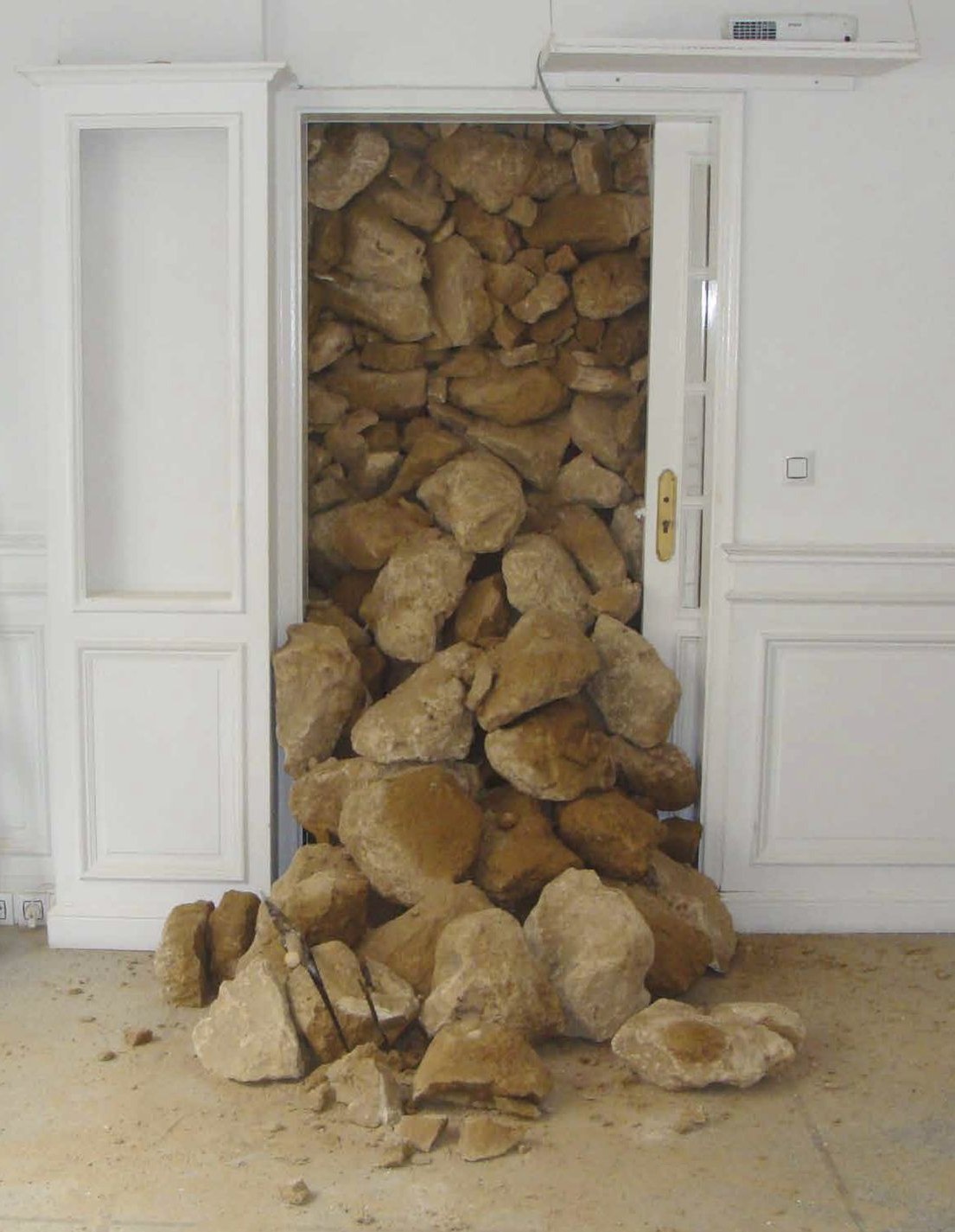
Research wins over productivity, experimentation over profitability, and the act of creating feeds on breath rather than calculation
Some places are not created but discovered within oneself. Le Cube was born of an intuition: art can break free of commercial logic and become again a space of dialogue, a bold breath. “It wasn’t a traditional exhibition space. I wanted a laboratory for experimentation,” says Elisabeth Piskernik, who founded Le Cube – independent art room in Rabat in 2005. Originally from Vienna, with degrees in art history and Romance philology, she was no beginner. Before settling in Morocco in 2004, she had already been involved in many artistic and cultural initiatives in Austria and abroad. At Le Cube she designs programmes to support emerging artists while placing social, cultural and political reflection at the heart of the artistic process. From the start a simple, radical principle prevails: research wins over productivity, experimentation over profitability, and the act of creating feeds on breath rather than calculation.
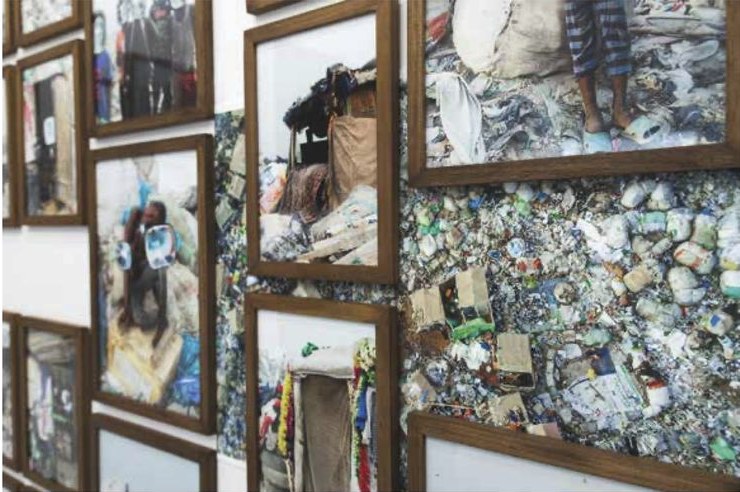
It all begins in a small ten-square-metre room with a cubic volume – hence the name. A space reduced to its simplest expression but already carrying the seed of total freedom. Constantly evolving, the place transforms over time and expands into a 70-square-metre flat that opens new perspectives. Exhibition after exhibition, its walls absorb stories, traces, gestures and voices. As artists take over the space, Le Cube acquires the capacity to hold each one’s memory. From there emerges the idea that the place itself holds a kind of consciousness, able to talk with those who pass through it and to create unexpected coincidences. Myriam El Haïk experienced this when she discovered that the flat had once been her grandmother’s home. Invited for a residency in 2017, she unearthed this intimate memory and made it the substance of her work, the place itself having called her to reconnect with her history. For her, “it’s as if Le Cube made possible something that could not have been born anywhere else.” A place where the unpredictable becomes tangible, where coincidences and encounters weave invisible continuities.
In the same vein, Salima S. El Mandjra recalls a chance dialogue with the artist Lucie Laflorentie, prompted by Le Cube itself. A few months before El Mandjra’s exhibition “Points de vue” (2021), Lucie Laflorentie had worked on the wall, engraving a sentence calling for reconnection: “We can still talk to each other, touch each other and see each other.” When she discovered the inscription, El Mandjra was struck by how the gesture resonated with her own work: in her series of nine illustrations from the book Saisissements, she explores the vertigo and loss of bearings that froze humanity in waiting. Faced with this unexpected echo, Salima S. El Mandjra describes Le Cube as “a place that forges artistic bonds.” Like an archaeologist of fleeting moments, it keeps sleeping pigments in its walls, witnesses of unsuspected encounters. This story of superimposed memories tells of the meeting of times, the possibility of a dialogue between what was and what is being made.
An ethics of transgression
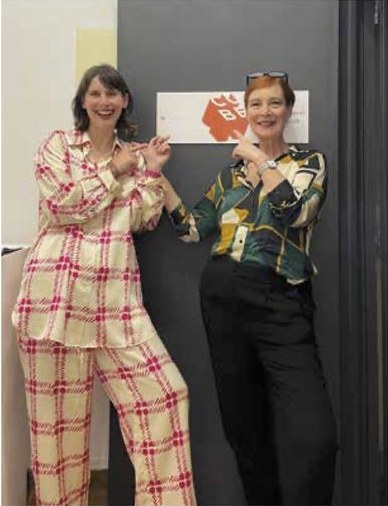
Le Cube is also a breeding ground for the boldest experiments. It is here that Collectif 212 formed in 2005, bringing together Amina Benbouchta, Hassan Echaïr, Safaa Erruas, Jamila Lamrani, Imad Mansour, Myriam Mihindou and Younès Rahmoun. Driven by a shared urgency to deconstruct norms, they imagined a refuge where art could breathe freely. “That is exactly what Le Cube gave us,” says Safaa Erruas, describing a place that spares artists the weight of predefined formats and market logic. Amina Benbouchta speaks of “absolute luxury, the luxury of complete freedom. At Le Cube, art is respected in its deep nature, made of resistance and hope.”
This ethics of transgression spreads and irrigates new territories. In this impetus New Generation appeared in 2007, a springboard and space for experimentation that would allow many emerging artists to rethink the boundaries of contemporary creation. Such as Mustapha Akrim and Redouane Arraoui, who pushed conventions in the end-of-residency exhibition “Rythme taillé,” where image and sound become plastic material. In 2016 Soukaina Joual presented “Halal,” an exhibition questioning the relation between the body and violence, inspired by the world of butcher shops and slaughterhouses. In 2021 Ziad Naitaddi closed his residency with an open studio for his project Withered Green, Thrived Red, a photographic and video work that questions the changes in identity tied to migration. Here the stake goes beyond exhibiting: it is about cultivating the emergence of a new scene that reinvents collective narratives.
So far, yet so close
Le Cube is also the daring of politicisation. Working on complex subjects means daring to reveal the uncomfortable and crossing the limits of the acceptable. It means “allowing artists to dive into the socio-political without fear of judgement or censorship,” says Mohammed Laouli, who worked in residency with the German artist Katrin Ströbel, who also speaks of “a spirit of radical freedom.” An atmosphere that made possible their project Frontières fluides, for which the two artists designed “nomadic boats” that travel navigable borders and go to meet the people who live there, gathering many stories that become the raw material of their work.
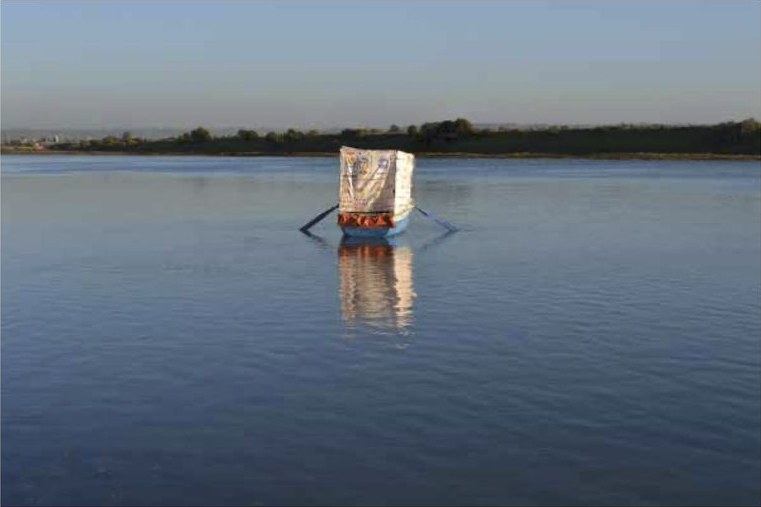
Le Cube is also the daring of politicisation. Working on complex subjects means daring to reveal the uncomfortable and crossing the limits of the acceptable
What really defines Le Cube is a closeness that is both intense and discreet. “So far, yet so close,” Ziad Naitaddi reflects. Far from imposing itself, the place acts as a moral presence “always there to support us when the need arises, without ever encroaching on our freedom,” he adds. Younès Rahmoun finds this support in “the bare trust Elisabeth places in artists,” with no wish to control but with pertinent guidance. Perhaps it is this openness to possibilities, this absence of a predefined trajectory, that lets works exist in their rawest, truest state.
Like a living organism, Le Cube has never stopped changing. Still active in its original form in Rabat, Le Cube now takes on a new identity with “Le Cube Expanded,” a platform that extends its activities internationally. “In 2021 I chose to live between the two countries, Austria and Morocco, and I told myself: the spirit of Le Cube, I’m taking it with me,” Elisabeth Piskernik explains. Le Cube Expanded invests in collaborations and projects in line with its philosophy, beyond the physical space in Rabat. Christine Bruckbauer, director of Philomena+ in Vienna, is one of the key collaborators in this expansion. For several years Philomena+ has hosted Le Cube’s artists and carried its questions abroad. For her, this shift from a fixed place to a nomadic entity was obvious: “After 20 years, Le Cube is no longer just a space in Rabat. It is recognised for its contemporary art programme and the people behind it. This nomadic evolution makes it possible to send exhibitions and concepts travelling without fear of losing its identity.” Away from its walls, Le Cube Expanded exists wherever its spirit is invoked; it becomes a borderless impulse, a presence that circulates without dissolving.
For now, Le Cube is celebrating its twentieth anniversary with a series of events throughout the year. A publication will look back on two decades of artistic exploration, while Le Cube’s archives will be opened to the public for a special three-day event with screenings and talks. Several artist residencies and public programmes will also mark the celebration, reaffirming the identity of this laboratory of thought and experimentation.