Friche La Belle de Mai, where art reinvents itself
For almost ten years, La Friche Belle de Mai has hosted Mediterranean artists in residence. The particularly strong presence of Moroccan artists made us want to discover this unique place of creation and intercultural exchange.
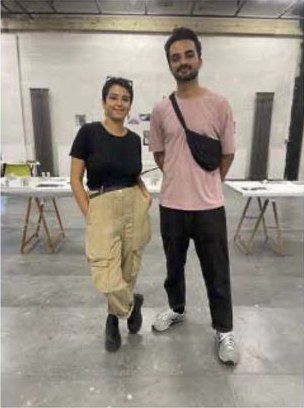
Behind its restored industrial walls, La Friche Belle de Mai almost seems to breathe. The metallic noises of the workshops mingle with the hushed conversations of artists, while visitors wander the galleries or watch a performance on a live stage. This hybrid place, both a space of creation and of exchange, has become an essential landmark for artists from around the Mediterranean. Since 2015 the Résidences Méditerranée programme has hosted artists from the southern shores, offering them a unique field of exploration. Among them, Moroccan artists stand out not only for their presence but for the lasting impact of their stay.
“When you arrive in Marseille from Morocco, you feel at home,” says Alban Corbier-Labasse, director of La Friche and former director of the Institut français in Casablanca. And for good reason: this port city shares with its Moroccan counterparts an instinctive hospitality, a warm way of receiving others. But beyond this cultural familiarity, Marseille offers a fertile artistic context. It is both cosmopolitan and rooted, a city where influences cross without ever erasing each other. If this geographic and emotional closeness softens the arrival of Moroccan artists, La Friche does not rely on that natural affinity alone. It structures the welcome. Organisations such as Fraeme, the A.M.I and Le Bec en l’air act as mentors, connecting artists with local resources, easing their access to archives or arranging meetings with other artists. “Making the landing as soft as possible is essential,” stresses Céline Emas-Jarousseau, head of visual arts.
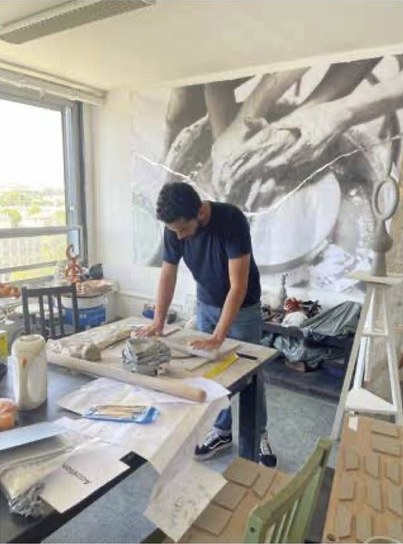
At La Friche Belle de Mai, the Résidences Méditerranée programme rests on one fundamental principle: allowing artists to move, literally and symbolically, in order to transform their practice. “Leaving your usual frame, meeting other artists, seeing works in the flesh, all of that shifts deep things in their approach,” explains Céline Emas-Jarousseau. This displacement, freed from the pressure of immediate results, becomes a driver of reflection and experimentation. Residents do not stay confined to their studios or to La Friche: they are encouraged to explore the many cultural scenes of the south of France. Such as Art-o-rama, an essential event for emerging galleries, which offers immersion in a unique cultural panorama stretching from Monaco to Montpellier by way of Arles and Nice. Likewise, the Rencontres de la photographie d’Arles open a door onto international photographic practices, where artists can draw on rich and complex visual dialogues.
Mobility does not stop at the region’s borders. “Going through Paris remains essential,” says Céline Emas-Jarousseau. The capital, nerve centre of the French and international art world, offers artists the chance to join wider networks, open dialogues with prestigious institutions and make their work resonate in larger circles. Artists, often rooted in very specific local contexts, find in this change of scene an opportunity to question their habits and redefine themselves. This back and forth between the intimacy of the studio and the outside of the city creates a unique flow. Ideas travel, cross, transform. Some artists leave with wider perspectives, new concepts that enrich their work. Others see their practice tip over, pushed by these physical and mental displacements that force them to give up certainties.
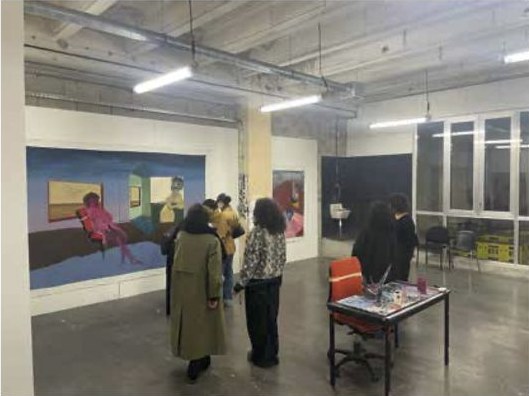
At La Friche nothing is fixed, nothing is imposed. Everything hums. Artists, ideas and practices meet, interpenetrate and transform
For Alban Corbier-Labasse, the metaphor of the beehive perfectly describes what happens at La Friche. He prefers the word to “incubator.” The first evokes living activity, spontaneous effervescence, organic interconnection; the second, the coldness of a linear, predictable programme. At La Friche nothing is fixed, nothing is imposed. Everything hums. Artists, ideas and practices meet, interpenetrate and transform. The hive takes shape first in the studios, where each resident works at their own pace but always in implicit dialogue with their surroundings. Then it overflows. In the house dedicated to residencies, shared meals become spaces of intense discussion, where artists from varied backgrounds exchange well beyond their practices. An idea is born from a comment, a project is enriched by a shared experience, and sometimes collaborations take shape without anyone planning them.
A subtle cultural diplomacy
This dynamic, specific to La Friche, is not confined to its walls. Marseille itself takes part in the ferment. Its streets, stages, inhabitants, archives, soundscapes and visual landscapes all become raw material for the artists. The relationship is deeply symbiotic. If the residents are enriched by the city, they in turn leave subtle but lasting marks: collaborations, traces in memories, ideas that germinate long after they leave. It is this constant circulation between inside and outside, between the individual and the collective, that gives La Friche its singularity.
The resident artists are not only seeking to show their practice: they take part in rewriting the relations between the two shores of the Mediterranean
Beyond offering a space for creation, Résidences Méditerranée asserts itself as a tool for dialogue between Morocco and France, a passage where art crosses borders to weave lasting ties. “Artists are the best ambassadors of their culture,” says Michel Richard, cultural attaché at the Institut Français du Maroc. At La Friche Belle de Mai, artistic language acts as a fluid bridge, saying what words alone sometimes struggle to express. By entering this dialogue, the artists are not only seeking to show their practice: they take part in rewriting the relations between the two shores. “Art transcends divisions while anchoring local identities,” Michel adds, insisting on this duality in which the singularity of a work speaks to a wider community. This model of cooperation, unique in its scale and fluidity, shows how art can move beyond traditional logics and become a lever for collective transformation. Each resident becomes both a maker and a ferryman, leaving behind a path that others will extend.
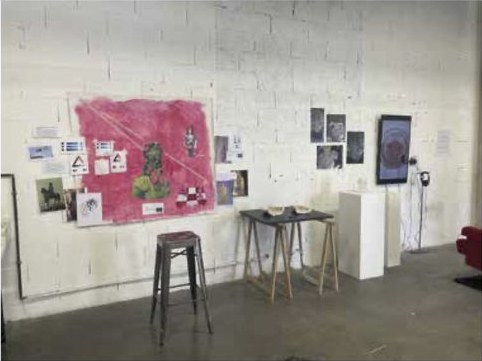
For many Moroccan artists, La Friche is a decisive step. Abdessamad El Montassir, hosted in 2017, saw his career take off after his time here, going on to a residency at the Villa Médicis. For others, such as Badr El Hammami, Marseille has become a home, a strategic base, a place of connection where influences from the South and from Europe intertwine to feed new artistic perspectives. But this springboard does not rest on grand promises. Céline Emas-Jarousseau puts it simply: “We set up the conditions, but all the credit goes to them.” This humility sums up the spirit of La Friche: a place that does not constrain but enables. The support given to artists, tailored to each, adapts to their specific needs and ambitions without demanding immediate results. This framework, both structured and flexible, leaves artists room to build their own paths.
A place that does not constrain but enables
Artists leave La Friche with concrete tools, wider networks, emerging collaborations, but above all with a renewed vision of their art and of their place in a globalised world
And often these paths exceed expectations. Artists leave with concrete tools, whether wider networks, emerging collaborations, or a practice enriched by encounters and discoveries. But more than that, they leave with a renewed vision of their art and of their place in a globalised world.
As Résidences Méditerranée approaches its tenth year, one question remains: how to give these unique trajectories even more value? A retrospective of the artists who have passed through La Friche, new initiatives to strengthen exchanges... There is no shortage of ideas. But the essential lies in this movement, this energy circulating between La Friche, Marseille and the southern shores of the Mediterranean. For Moroccan artists, La Friche is not a final destination. It is a space of discovery and transformation. A place where you find yourself through the other, where you build bridges that are invisible but solid. And for Marseille, La Friche is much more than a cultural site: it is a living witness to the most precious things art can offer in its capacity to transcend borders.