Salima Naji, “A culture that endures is a deep culture”
The “Amazighes” exhibition at the Mucem · Co-written with Emmanuelle Outtier
A doctor of anthropology, author of many books on Amazigh questions and a renowned architect, Salima Naji is co-curator of the exhibition “Amazighes: cycles, parures, motifs,” which rethinks Amazigh identity far from folkloric clichés and highlights the contemporary vitality of this ancient culture.
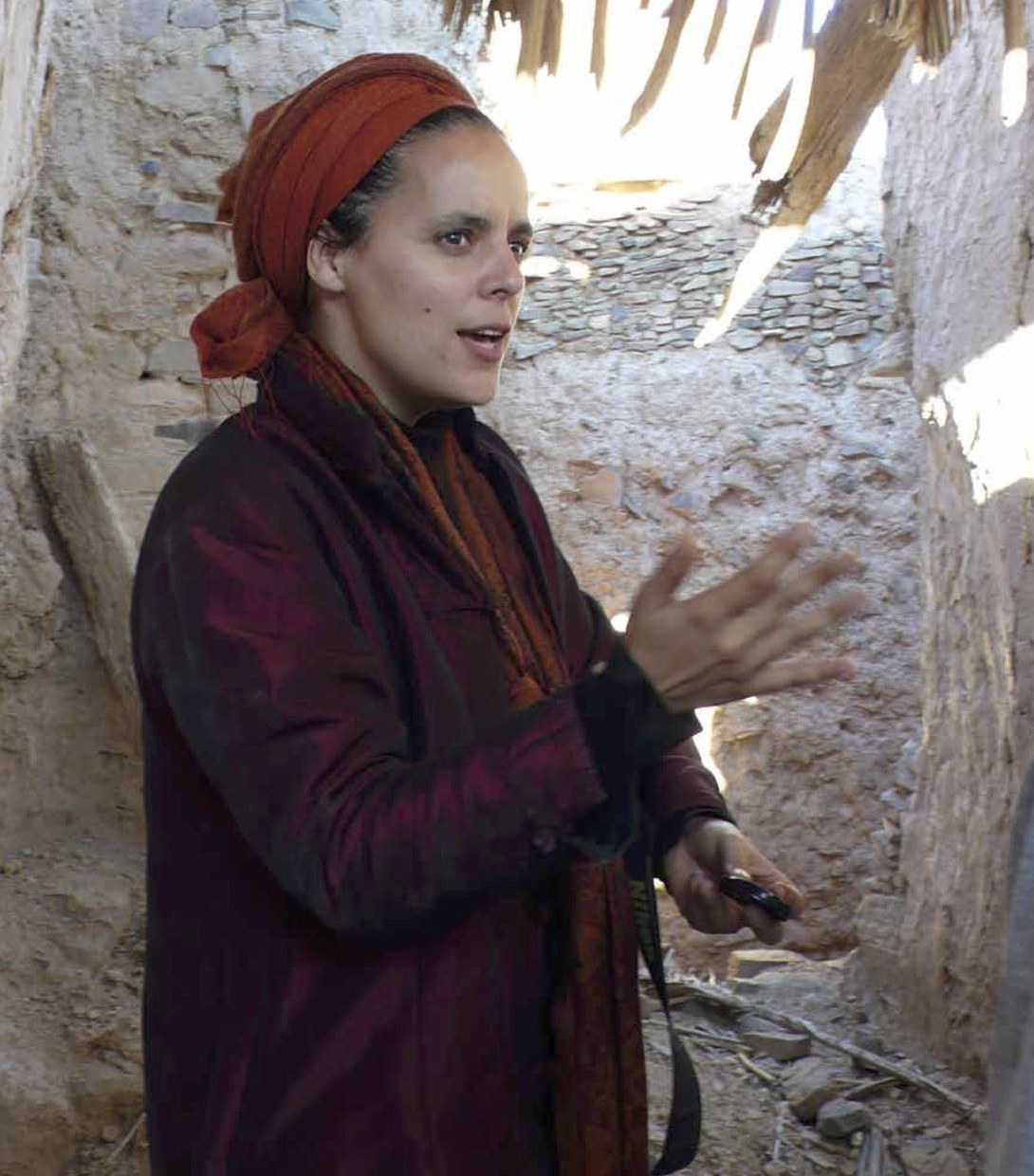
The Mucem in Marseille becomes the epicentre of a fascinating anthropological reflection. The fruit of a collaboration with the Fondation Jardin Majorelle in Marrakech, the exhibition “Amazighes” makes a fundamental break in terminology from the outset. Dropping the term “Berber” is much more than a semantic adjustment: the endonym “Amazigh” carries the notion of free or noble people, an act of reclaiming identity that the curators Salima Naji, architect and anthropologist, and Alexis Sornin, director of the museums of the Fondation Majorelle in Marrakech, chose to celebrate, far from the Western projections that long confined them to reductive categories.
The very structure of the exhibition, which brings together more than 150 objects from Morocco, Algeria, Tunisia and the Sahel, escapes the chronological linearity that usually governs the presentation of non-European cultures. Rather than a straight narrative from origins to modernity, the route unfolds in thematic constellations that interpenetrate and reflect the cyclical conception of time proper to Amazigh societies, in which seasonal return prevails. Claudine Bertomeu’s scenography gives material form to this conceptual approach through deliberately permeable exhibition spaces that let visitors make visual connections between sections. Time sequences telescope, bringing heritage objects and contemporary works into dialogue within a single sensory sphere.
Against the reductive theories that long interpreted some Amazigh practices as mere superstition, the exhibition restores their philosophical complexity
Salima Naji and Alexis Sornin’s proposal also shatters the illusion of a monolithic Amazigh culture. It reveals the diversity of cultural expressions from the different regions of the Maghreb and the Sahel, questioning the very relevance of a homogenising category. Against the reductive theories that long interpreted some Amazigh practices as mere superstition, the exhibition restores their philosophical complexity and brings out a true cosmology in which material signs mediate between the visible and the invisible. While it shows how Amazigh artefacts were both raised to the rank of art objects and stripped of their functional and symbolic complexity by the Western gaze, the exhibition refuses to shut itself into an accusatory or nostalgic stance. On the contrary, it bears witness to the persistent vitality of a culture in perpetual reinvention.
One of the first things you do in the Mucem exhibition is replace the term “Berber” with “Amazigh.” What motivated that choice?
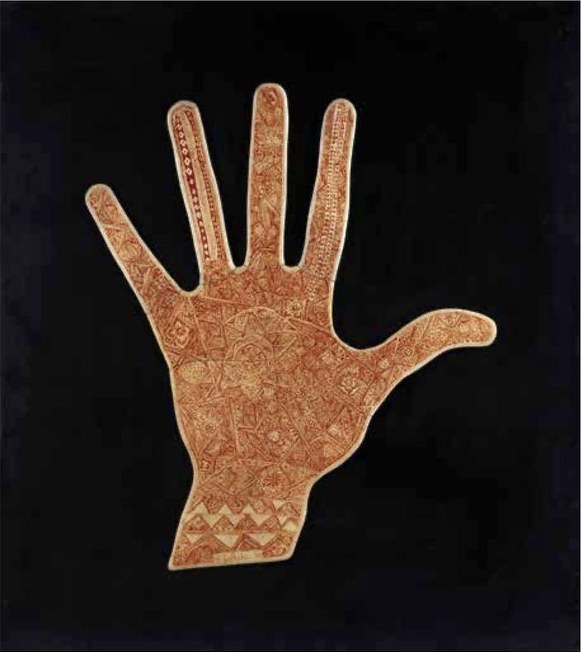
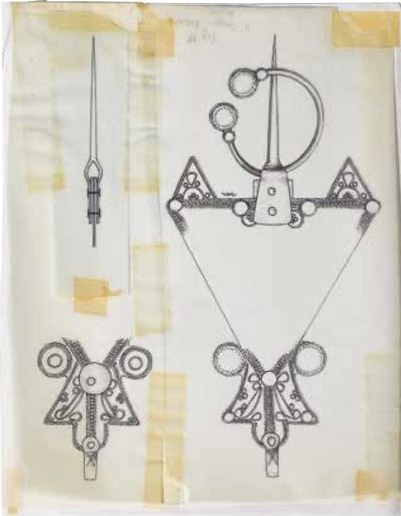
It is about calling yourself by your own name and no longer being the Other’s barbarian. “Berber” is said to derive from the word “barbarian.” So there is, in a postcolonial claim, the desire to name ourselves better, to know ourselves better. In the feminine plural they are the “Amazighes,” and with one letter, the “e” we add to the exhibition’s title, we point to the fundamental role of women; the aim is to show their major role in transmission. In these troubled times we also wanted to value what is held in common, shared heritages, singular or universal. For example, the mother goddesses of the Canary Islands are represented by triangles engraved in rock, a form also found in some ancient engravings in Morocco. It shows the use of the motif known as the fibula, which appears from the Canaries to Egypt, as far as Sardinia and the Azores. It is the same obvious, very graphic aesthetic, spreading across every medium. The question of a matrimony, a heritage passed through women, is also a question of women rewriting their cultures. From skin to walls, from faces to weavings, it is one relation to the world: faced with chance, with uncertainty, what do you do? Protect your home, your people, and always anticipate. Make peace with your immediate environment: the one that feeds, the one that gives or takes life. I wanted to echo what Françoise Vergès calls “new memorial cartographies,” spaces where cultural heritages can unfold in all their complexity, far from fixed or marginalised representations. And so well beyond decoloniality.
Amazigh identity is often seen through a homogeneous prism, but the reality is far more complex and diverse. How would you describe Amazigh identity across its geographic, cultural and social dimensions?
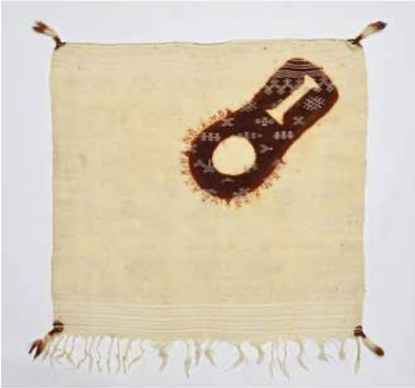
From the very start of the exhibition we wanted to establish this idea of “pan-Amazighness” by offering a monumental map without borders, embracing Tamazgha from Egypt to the Canary Islands, from the Sahel to northern Europe. The map, which inscribes the peoples recorded by modernity – since we could not include all the ancient civilisations of Antiquity or before – aims to break the homogeneous prism often attached to Amazighness. The Canaries are included in this vast territory, which remained on the margins of Islamisation and whose archaeology has yielded precious information. Their presence mattered a great deal to me because, though little known, their history is closely tied to the neighbouring African shores.
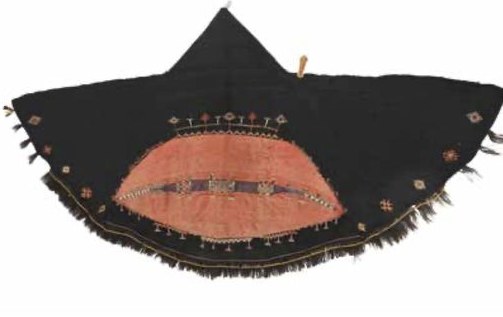
I also wanted to avoid the ethnographic present so dear to the colonial sciences. Alongside our exhibition, other, more critical ones are currently on, notably at the Quai Branly. Our approach builds bridges and fruitful alliances, and proposes other paths. In the exhibition we highlight initiatives that value the transmission of knowledge. Hence the screening of films, those by Marc Beviglieri on the healer Fatima Belharch in Tiznit, or those by Myriem Naji1. Through her films, Myriem Naji documents and shares craft techniques to make them accessible to the public. A recognised expert, she was recently chosen to lead a new form of collecting artefacts and techniques, putting them within reach of users as part of the EMKP (Endangered Material Knowledge Programme). It is an initiative led by the British Museum that aims to digitise know-how and practices, some of which are disappearing. The work is carried out in collaboration with source communities, notably through an audiovisual library devoted to the making of textiles and tools.
The Amazigh have a history thousands of years old, yet they have often been marginalised, both culturally and historically. In your view, what are the main forces that have allowed this identity to resist erasure over the centuries?
A culture that endures is a deep culture, one that readapts and draws on the fertility I just mentioned. This very ancient civilisation is tied to agrarian cycles and economic modes that allowed it to last. That is why it is now in danger from a kind of acculturation that apes its appearance – for festivals, for identities handed out quickly – without ever reaching its essence. In fact, it is often when people fuss around an entity that it can die out. And at the same time, it is a visceral, vital need. The rural world used to be despised; today, thanks to museums, everyone finally recognises the true value of this heritage. In the first days of the exhibition in Marseille, some Amazigh women of a certain age, from the Chaouia, Kabylia or Tunisia, came and said they had forgotten how beautiful this culture was. An exhibition subsumes, sets things resonating, makes visible questions that would otherwise have stayed inaudible. That is why I think a real rediscovery is under way. And I see, on Instagram and elsewhere, a young generation reclaiming a wisdom that speaks to them.
The exhibition sets out to explore the contemporary renaissance of Amazigh culture. Which artists and current practices best embody this dynamic of reinvention, in your view?
“Showing artists such as Belkahia, with his skins, or Amina Agueznay, who builds a bond with women artisans by de-anonymising their work, was essential to us”
I wanted co-presence and dialogue. Showing artists such as Belkahia, with his skins, or Amina Agueznay, who builds a bond with women artisans by de-anonymising their work, was essential to us. The aim was to show the great current vitality of Amazigh creation alongside a wide range of traditional objects, some better known to the general public than others. Amina Agueznay works with weavers to bring a repertoire of signs into her work. Finally, by presenting contemporary tattoos and current scripts in echo with ancestral practices, we wanted to illustrate the continuity and adaptability of these traditions.
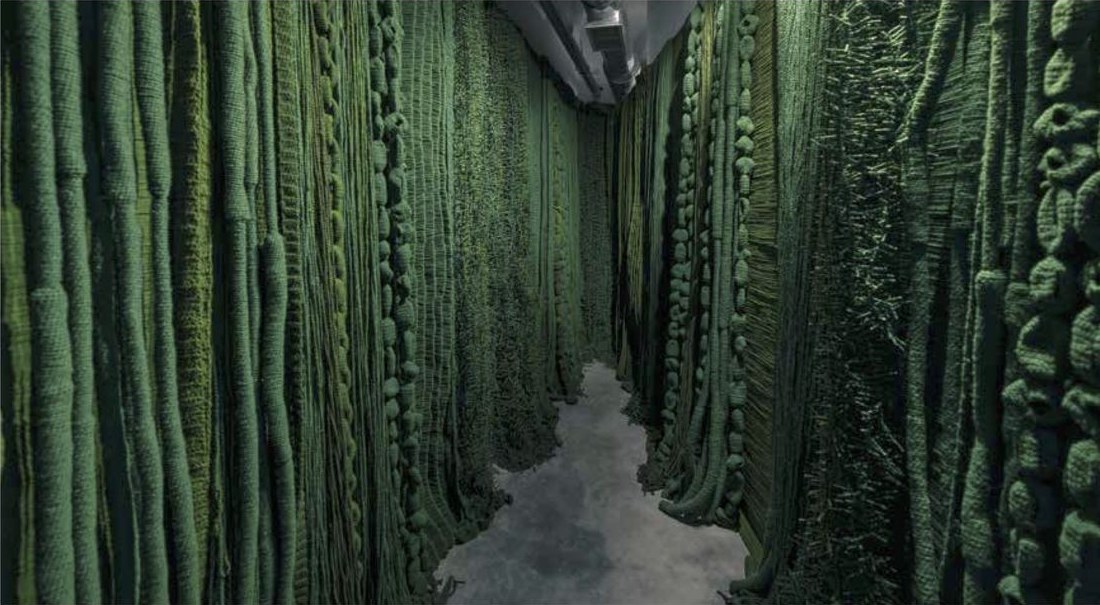
The context of globalisation does not erase everything: we are seeing reinvented rituals, practices taken up again, linked to the land, which have been especially significant in recent years in Amazigh worlds struck by ever more dramatic drought. The exhibition at the Mucem, as a museum of society, highlights these contemporary modes of expression, nourished by dialogue with the weavers of the Anti-Atlas and Middle Atlas in Morocco. Or with craftsmen and craftswomen – ironsmiths, jewellers, potters, farmers, healers – aware of their role of transmission within their communities.
The texts gathered in the catalogue, like recent films, celebrate the vitality of these active communities. A vitality long denied in the name of pragmatism and “modernity,” when what we are witnessing is a true cultural regeneration.
- Myriem Naji is an anthropologist specialising in material culture and knowledge, work and techniques. She is affiliated with the Department of Anthropology at UCL (University College London), a member of the Centre for the Anthropology of Technics and Technodiversity (CATT) and a founding member of the “Under the Carpet” group. Her research covers craft production, processes of making and creation, know-how and its economic role, market dynamics, the body, appearance and clothing, textiles, ceramics and the arts of fire. She has taken part in many exhibitions in Europe and the United States and has curated, notably in London at the Brunei Gallery in partnership with SOAS, since 2012. ↩