When the future repairs the past
What if imagining the future were not an escape but a suture? In a world where History, confiscated, leaves behind fractured memories and identities in exile, some artists of the Moroccan diaspora think of what is “to come” as an act of resistance.
Mounir Ayache reinvents his own family history by imagining his grandmother as a cybernetic super-warrior facing a tyrannical artificial intelligence. Anticolonial memory rubs against contemporary questions of surveillance, control and power
Why imagine the future when History seems to have been confiscated from us, when exile ploughs through identities, when migratory, ecological and political crises shatter any possibility of continuity? There is a contained vertigo in this question. The very idea of “becoming” seems derisory against the litany of past and present wars, against the borders being raised and the memories being erased. And yet. It is precisely in the breach left by official history that the need to create slips in.
If the temptation to imagine tomorrow may look to some like an escape, a refuge in illusory projection, the artists of the Moroccan diaspora use it rather as a mirror held up to the present. They do not practise a futurism blinded by naive utopia or hollow fascination with technology. On the contrary, theirs is an engaged futurity: a creative gesture that reverses temporal causality so that the imagination of the future lights up and transforms the present. Faced with the fractures running through our time – experiences of war and exile, migration and displacement, social struggles, questions of identity, ecological emergencies – imagining becomes a political, critical and poetic act, a gesture of repair.
Giving form to stories (again)
When Mounir Ayache reinvents his own family history by placing his grandmother at the centre of a futuristic set-up, a whole programme of repair is set in motion. The French-Moroccan artist turns Khadija, a matriarchal figure, into a cybernetic super-warrior facing a tyrannical artificial intelligence. In this confrontation, Morocco’s anticolonial memory rubs against contemporary questions of surveillance, algorithmic control and deterritorialised power. Here fiction is not ornament: it becomes material for speculative insurrection, a stage on which stereotypes are undone.
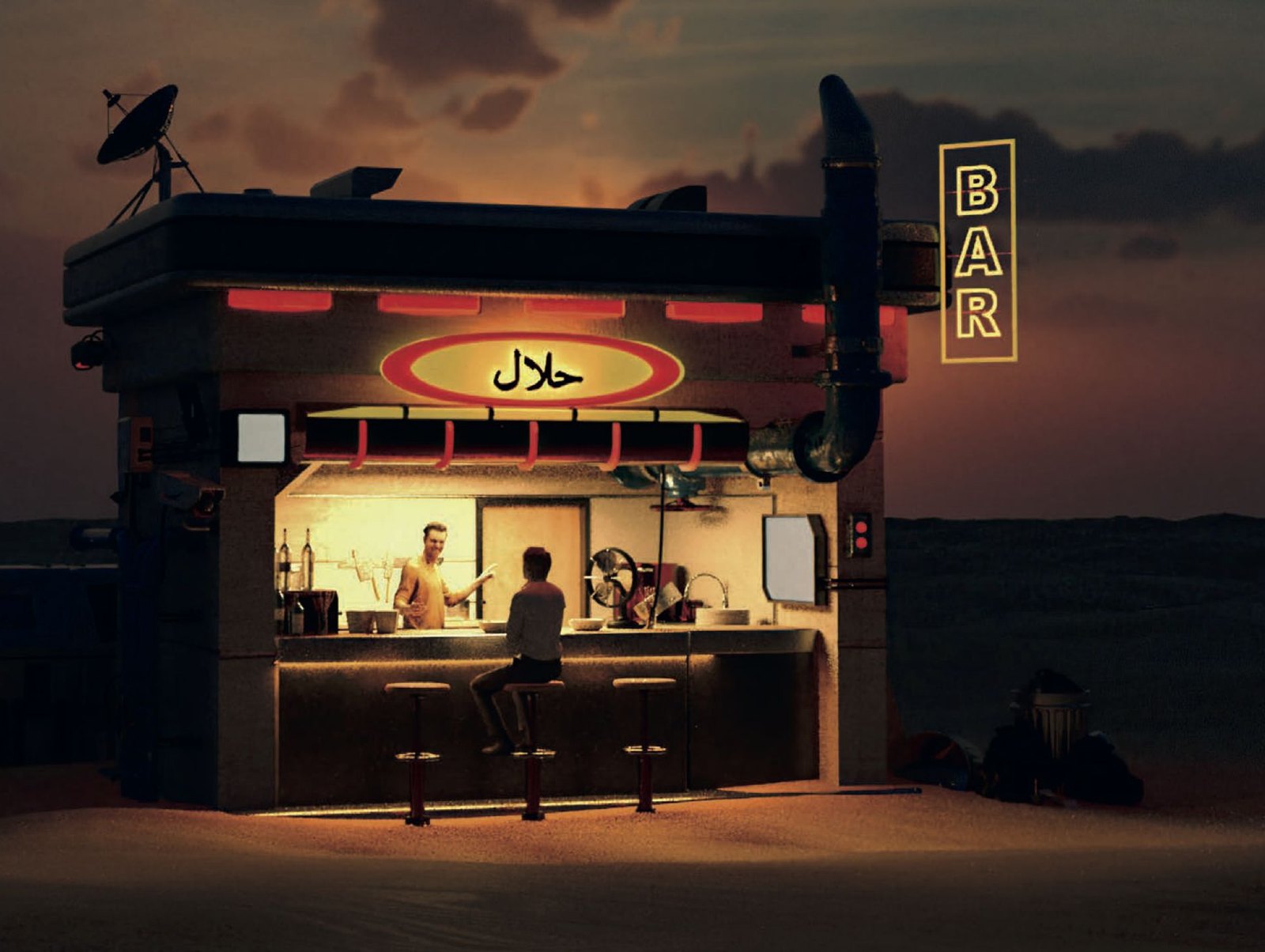
Sometimes it is not bodies that are summoned back but places – mental landscapes left vacant by History, made inaccessible by exile, or simply neutralised by the colonial gaze. Muhcine Ennou, now based in Amsterdam, enters this breach with the same force of displacement. Where Ayache gives voice back to a familiar body, Ennou reconquers a territory he has never lived in but whose absence clings to his skin: the Sahara. He fills its mineral expanse with fragments of urban life stranded in the aridity – an unlikely cohabitation of signs, where globalised modernity is grafted onto a fantasised territory. What if these hybrid, dissonant, paradoxical modernities became precisely the bricks of another form of continuity? But these digital landscapes can also be read as a commentary on exclusion – the no man’s land the West fantasises, maps and instrumentalises. The desert said to be “virgin” is in fact a space saturated with erasures, repressed stories, presences made invisible. By inserting himself into it through digital art, Muhcine Ennou does not seek to rehabilitate it as “origin” or “heritage” but to decolonise it as a surface for contemporary inscription. He refuses the idea of the desert as a non-place, or worse, as the “hinterland” of an inaccessible modernity.
The symbolic reconquest of territories does not stop at desert landscapes. History has erased not only places but a whole relation to the world, to the land, to the living, which forced modernity has ravaged. In an insurrectionary vein, AZ OOR deploys speculative fiction as a soft weapon, a tool of poetic drift to dismantle hegemonic narratives. Calling himself an “Amazigh futurist,” the artist, born in Aghmat and now living in Rotterdam, campaigns for a rebirth of Indigenous consciousness and cosmologies against the ravages of the “developmentocene,” the present age in which the race for progress drains the life out of cultures and nature. His ongoing project, The Fable of the Agronauts – a nod to the Argonauts of Greek mythology – overturns the colonial myth of the native frozen in a pastoral past by summoning a fleet of hybrid Amazigh beings, nomads of space and time, carriers of forgotten knowledge. This immersive installation refuses the linear logic of modernity in favour of a return to the ancestors as a springboard towards the future. Here, imagining the future goes through excavating ancestry: it is in the roots that one finds the material for other futures.
Behind the fight against cultural erasure lies an ecology of reconciliation. AZ OOR reminds us that we cannot dream the future without restoring our bond with the living. The soil, plants, agricultural rituals, breaths, everything the Anthropocene has silenced, regains here the right to exist. It is no longer the human who speaks on behalf of the world: it is the world relearning to speak through the human. The same urgency to decentre the gaze, to uproot anthropocentrism, to reimagine our place in the ecosystem – no longer above it but in relation – appears in another form in the work of Lina Laraki.
What the diaspora sews back together
In her film The Last Observer, the artist, born in Morocco and based in France, imagines a plant dreaming of a “last observer”: not a providential man but a post-human consciousness that would still remember. It can also be read as a metaphor for exile. To speak of it, Lina Laraki uses the portmanteau “arabre,” a contraction of “arabe” (Arab) and “arbre” (tree). This neologism, both tender and ironic, thinks of identity as a migrant plant, without fixed ground but able to put down roots wherever the soil allows. A potted plant, always in transit.
But what happens when it is no longer stories that are made but situations that are activated? When repair is not a gesture laid on the image but a breach opened in reality? The point here is no longer to inhabit the past, or even to project the future, but to provoke a disturbance in the moment. To make interaction itself a space of dissent. This shift is crucial. In the practices of Yassine Khaled and Yanis Ratbi, the stake is not only to represent but to make things act, to force reality to respond. Their works are not offered as objects to contemplate but as devices of engagement – zones where one is called on to take part, to join the game, to become oneself a relay, an interface, a disrupter.
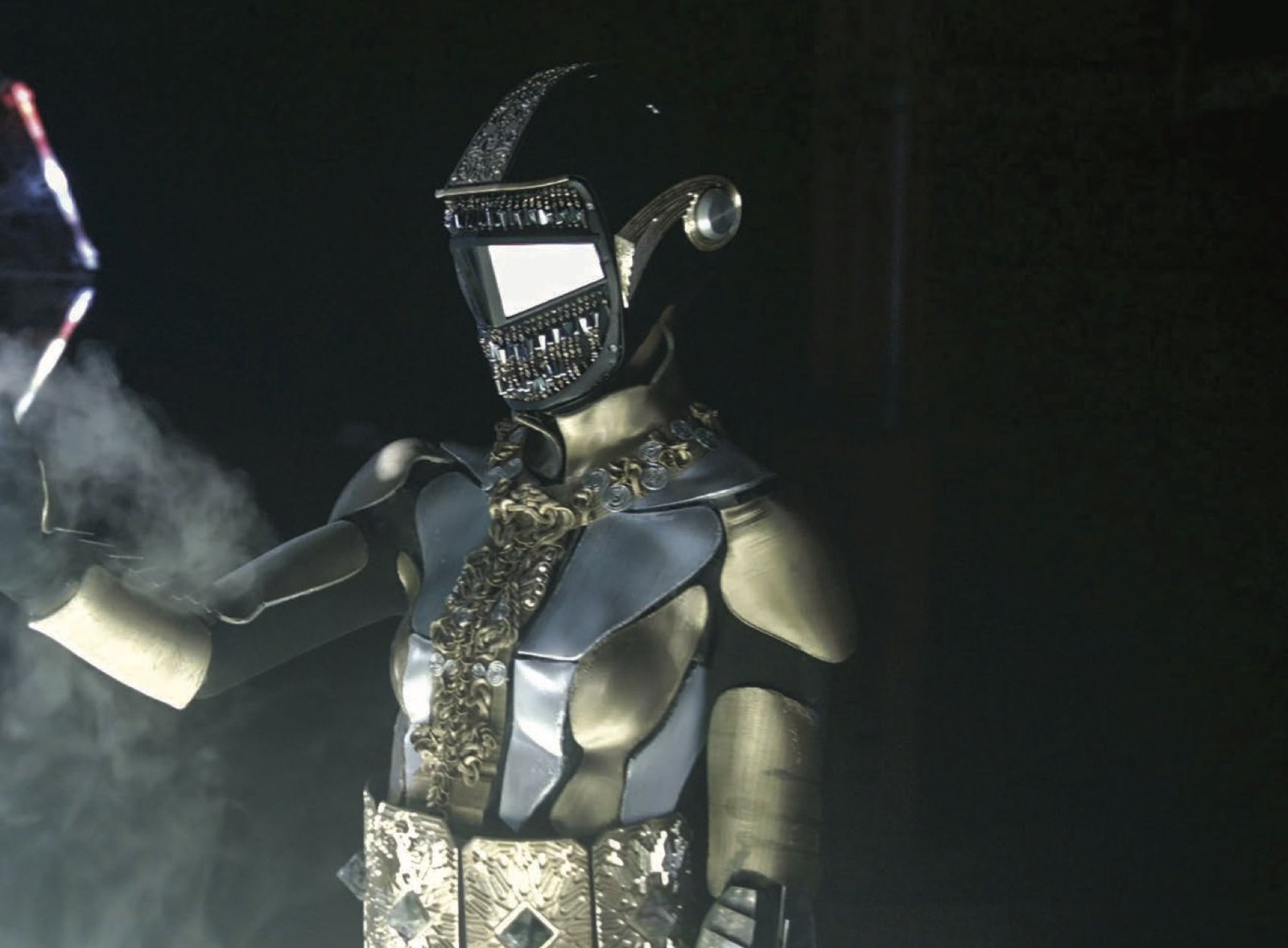
In Monitor Man, Yassine Khaled, based in Finland, walks the streets of Western cities wearing a screen helmet connected live to people on the other side of the territory, inviting passers-by to talk with an “invisible” person who is nonetheless very real. The physical body is made mute, reduced to the function of an interface, a screen, a human avatar. The artist does not stage a dystopian future: he reveals it. He lays bare the way our societies celebrate connection while consolidating exclusion. Behind the illusion of a globalised world, he exposes the invisible hierarchies of mobility: who has the right to see and be seen? Who can move and who stays confined to the screen? The digital becomes a theatre of alienation, a mirror held up to our political geographies.
A resolutely political stance
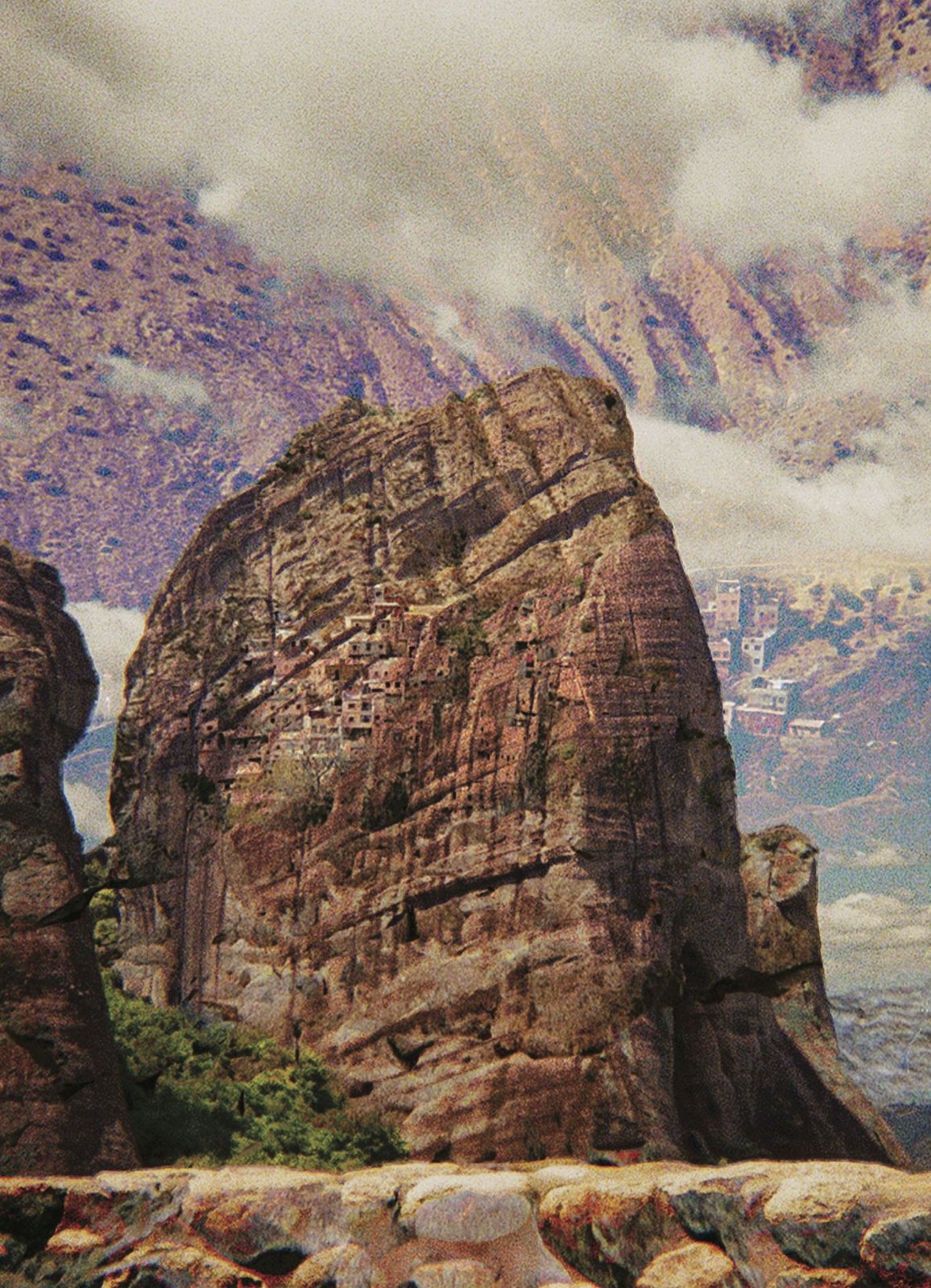
Against this map of compartmentalisation, Yanis Ratbi, alias Syncretical, sketches another gesture. His artist name says it already: syncretism as method. In Seules les montagnes ne se croisent pas, he superimposes the reliefs of the Ourika (Morocco) and the Meteora (Greece), erasing the lines to bring out hybrid geographies. Where Khaled reveals the violence of borders, Ratbi proposes a poetic repair – not by crossing the obstacle but by dissolving the very logic of the line. And who knows, perhaps the future no longer has a map. Perhaps this space to come is not to be occupied but to be imagined otherwise, without coordinates, without customs, without an outside.
So, back to the first question: what is the use of imagining the future? Because the present is not given to us, it is conquered every day, and memory is not a dead archive but the sap that feeds the impulse of life. The artists of the Moroccan diaspora carry the marks of these tears – exile, colonisation, discrimination – and yet they create, they tell, they speculate; that is, they open room for manoeuvre in what we thought was sealed. This stance is resolutely political: making continuity a gesture of resistance against the dominant narratives that impose rupture. Rupture between past and future, between East and West, between the human and nature… between “us” and “the others.”